

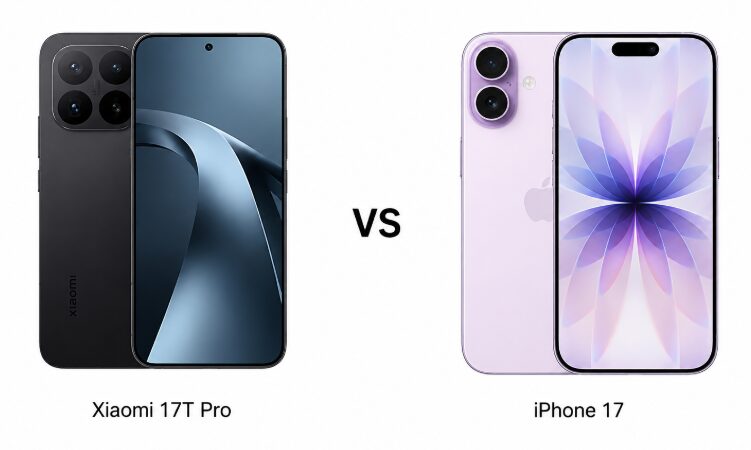
Xiaomi’s 17T Pro is the spec-sheet bruiser here: a bigger display, a much larger battery, faster charging, more RAM, and a periscope zoom camera, all for less money than the iPhone 17. Apple still has the familiar advantages that tend to outlast launch-day comparisons – tighter software-hardware integration, long support, and ecosystem lock-in – but if you judge these two like plain hardware, Xiaomi comes out swinging harder.
Xiaomi 17T Pro vs iPhone 17 display and design
The Xiaomi 17T Pro leans into the maxed-out flagship formula with Gorilla Glass 7i on both sides, an aluminum frame, IP68 protection, an under-display fingerprint scanner, dual SIM support, and even an infrared blaster. The iPhone 17 takes the cleaner route with Ceramic Shield 2, IP68, Face ID, and satellite communication features. One is trying to be useful in every direction; the other is trying to look effortless while doing less.
That split continues on the screen. Xiaomi offers a large AMOLED panel with a 144Hz refresh rate, Dolby Vision, HDR10+, very high peak brightness, and 3840Hz PWM dimming. Apple counters with a smaller LTPO Super Retina XDR OLED display, adaptive 120Hz refresh, strong color accuracy, HDR support, and an anti-reflective coating. Xiaomi wins the headline numbers, while Apple is still the safer bet for people who value tuning over theatrics.
Battery and performance numbers
Under the hood, the Xiaomi 17T Pro uses the MediaTek Dimensity 9500 with up to 16GB RAM and UFS 4.1 storage, while the iPhone 17 relies on Apple’s A19 chip with 8GB RAM and NVMe storage. The usual caveat applies: Apple can make smaller memory figures behave better than rivals through software optimization, but raw hardware freedom is still on Xiaomi’s side.
The battery gap is not subtle. Xiaomi pairs its 7000mAh silicon-carbon battery with 100W wired charging and 50W wireless charging. The iPhone 17 offers a 3692mAh battery, fast wired charging, and 25W MagSafe wireless charging. For travelers, gamers, and anyone tired of hovering near a wall socket, that is a very easy argument to understand. It also reflects a broader pattern in the Android flagship market, where battery size and charging speed keep getting more aggressive while Apple usually moves more cautiously.
Xiaomi 17T Pro vs iPhone 17 camera and price
Xiaomi also has the more flexible camera setup: a 50MP main sensor, a 50MP periscope telephoto camera with 5x optical zoom, and a 12MP ultrawide lens, plus Leica tuning, advanced HDR processing, 8K recording, and professional video modes. The iPhone 17 sticks with a dual-camera system built around 48MP main and 48MP ultrawide sensors. Apple’s output is usually more consistent, especially for video, but the lack of a dedicated telephoto lens leaves it at a real disadvantage in versatility.
Pricing makes the comparison even sharper:
- Xiaomi 17T Pro: around ₹75,000
- iPhone 17: around ₹83,000
Apple’s premium is easier to justify if you already live in its ecosystem, use Apple Pay, or care deeply about resale value and long software support. For everyone else, Xiaomi’s offer looks unusually aggressive: more hardware, less money, and fewer apologies.
- Xiaomi 17T Pro: 144Hz AMOLED, 7000mAh battery, 100W wired charging, 50W wireless charging, up to 16GB RAM, 5x telephoto zoom
- iPhone 17: A19 chip, 120Hz LTPO OLED, 3692mAh battery, 25W MagSafe wireless charging, Face ID, satellite communication
- Best for Xiaomi: users who want maximum specs for the money
- Best for iPhone: buyers already invested in Apple’s software and services
The open question is not which phone has the better spec sheet; that answer is already obvious. It is whether buyers keep rewarding Apple’s polish enough to ignore the hardware gap, or whether Xiaomi’s more aggressive formula starts looking like the smarter flagship bet.