

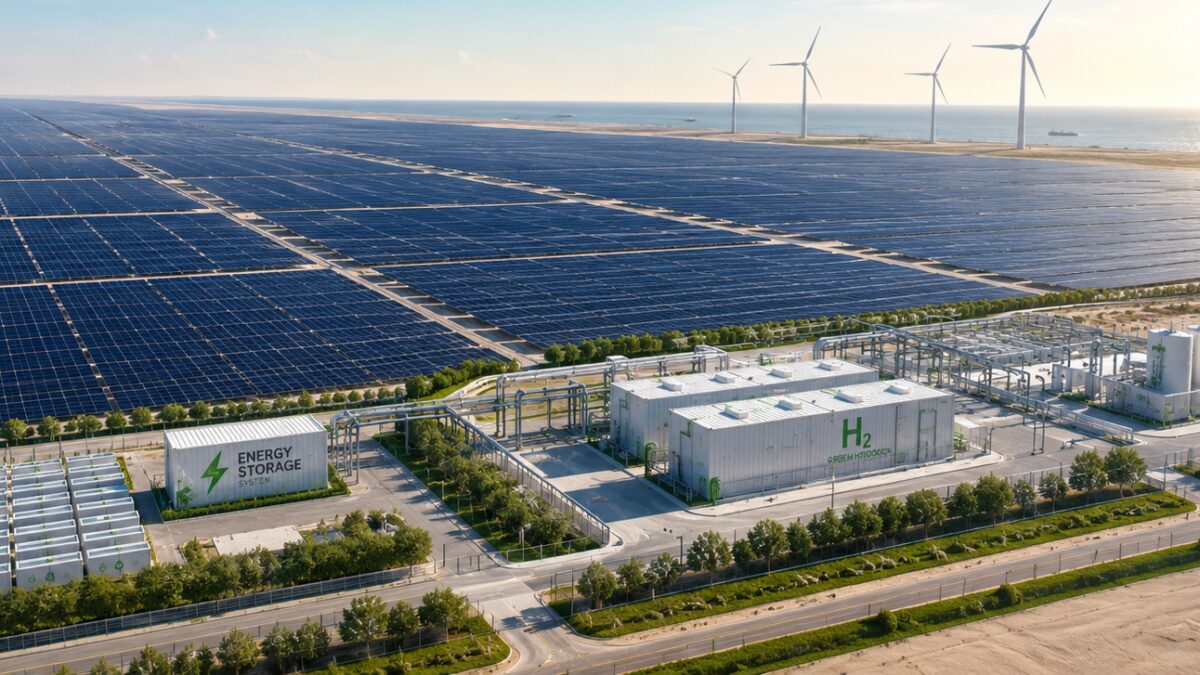
China has put a coastal energy complex into operation that combines solar power, battery storage and green hydrogen production under one digital control system. Built in Rudong county in Jiangsu province, the China’s 700,000-panel AI energy hub is designed to act less like a single power plant and more like a miniature energy economy: generate electricity, store some of it, turn some into hydrogen, and dispatch the rest into the grid.
The scale is doing most of the talking here. In less than eight months, builders installed more than 110,000 reinforced concrete piles and mounted about 700,000 solar panels on top, all while working on tidal mudflats where heavy equipment could operate only in narrow windows. That sort of speed is impressive, but it also reflects a broader Chinese pattern: the country keeps pairing brute-force buildout with increasingly sophisticated software to squeeze more value out of renewables.
A 400 MW solar plant with batteries and hydrogen
At the center of the cluster is a 400 MW photovoltaic station, backed by a 220 kV shoreline substation and a 120 MWh energy storage system. The battery bank is there to smooth out solar swings and cover peak demand, which is the part of the renewables story that glossy launch videos usually skip. Here, it is treated as infrastructure, not an afterthought.
- Solar capacity: 400 MW
- Storage: 120 MWh
- Hydrogen output: 1,500 m3 per hour
- Potential annual green hydrogen production: up to 180 tons
Why the hydrogen piece matters
The hydrogen unit gives the project a second life beyond feeding electrons into the grid. When solar output peaks, surplus power is diverted to electrolysis, and the resulting hydrogen already has customers: chemical plants and operators of hydrogen infrastructure have signed contracts for the output. That matters because plenty of renewable projects can generate electricity; far fewer can prove they can monetize excess power without wasting it.
The setup also points to a larger shift in China’s clean-energy buildout. Utility-scale solar is now common enough that the competitive edge is moving toward integration: combining generation, storage and flexible industrial use in one system. Japan, Europe and Gulf states are chasing similar hybrids, but China is moving faster on the industrial plumbing.
Built to protect the coastline, not bulldoze it
The site sits on coastal mudflats that are regularly flooded by tides, which forced the team to rethink the usual construction playbook. Cable lines, power equipment and inverter stations were placed on elevated structures, while service routes were built as raised bridges. It is a practical design choice, but also a quiet admission that large energy projects increasingly have to justify themselves environmentally as well as electrically.
For China, the Rudong cluster is more than another ribbon-cutting moment. It is a test case for whether AI-controlled energy parks can make renewables dispatchable, hydrogen commercial and coastal land use less destructive at the same time. If this model scales, expect more projects that look less like power stations and more like tightly managed industrial ecosystems.