

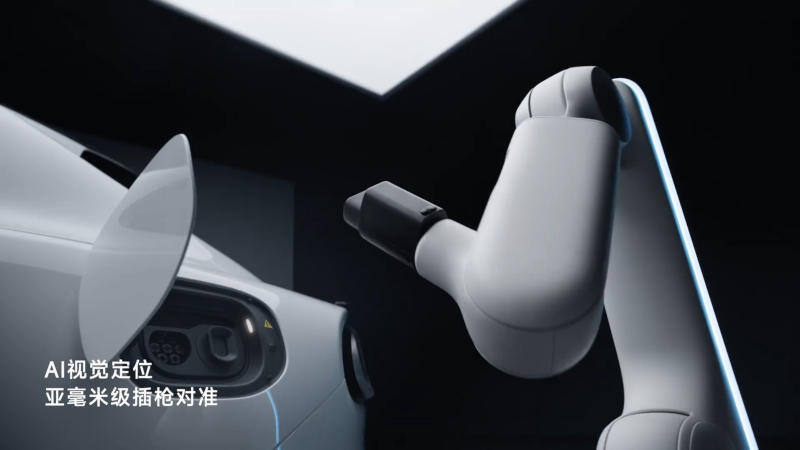
Xiaomi has shown off a robotic arm for its home EV charging setup that can plug the cable into an electric car without the owner doing the awkward bit by hand. The company is leaning hard into small-space convenience here: the charger body is just 152 mm wide, and Xiaomi says it can be controlled remotely from a smartphone.
That is a neat little flex, but it is also a sign of where home EV charging is heading. Competitors in the charging hardware market have been pushing smarter, more connected units for years; Xiaomi is simply adding a physical robot to the software layer, which is the kind of move that gets attention far beyond its own fan base.
Xiaomi’s current home EV charging hardware
The company already sells 7 kW and 11 kW home charging stations. The 7 kW model measures 400 × 180 × 120 mm, works from a 220 V single-phase supply, and comes with a 640 g charging unit. The 11 kW version keeps the same dimensions but connects to a 380 V three-phase supply, and its charging unit weighs 770 g.
- 7 kW home charger: 400 × 180 × 120 mm, 220 V single-phase, 640 g charging unit
- 11 kW home charger: same size, 380 V three-phase, 770 g charging unit
- Portable charger: up to 2.8 kW on 220 V, with vehicle-to-device reverse charging up to 3.5 kW
A robot arm Xiaomi has been teasing for a while
This is not Xiaomi’s first flirtation with robotic charging. The company previously mentioned a manipulator while talking about Xiaomi Pilot Technology and its automated parking system, and it has also filed a patent for charging electric vehicles using specialized unmanned trucks. In other words, this looks less like a one-off demo and more like Xiaomi testing how far it can push automation around the garage.
Xiaomi has not said when the robotic charging arm will ship, or how much it will cost. That leaves the usual question hanging over the demo: clever concept, yes, but will buyers want a robot to do a job that takes a few seconds, or will this stay in the ”nice to show at a presentation” category?