

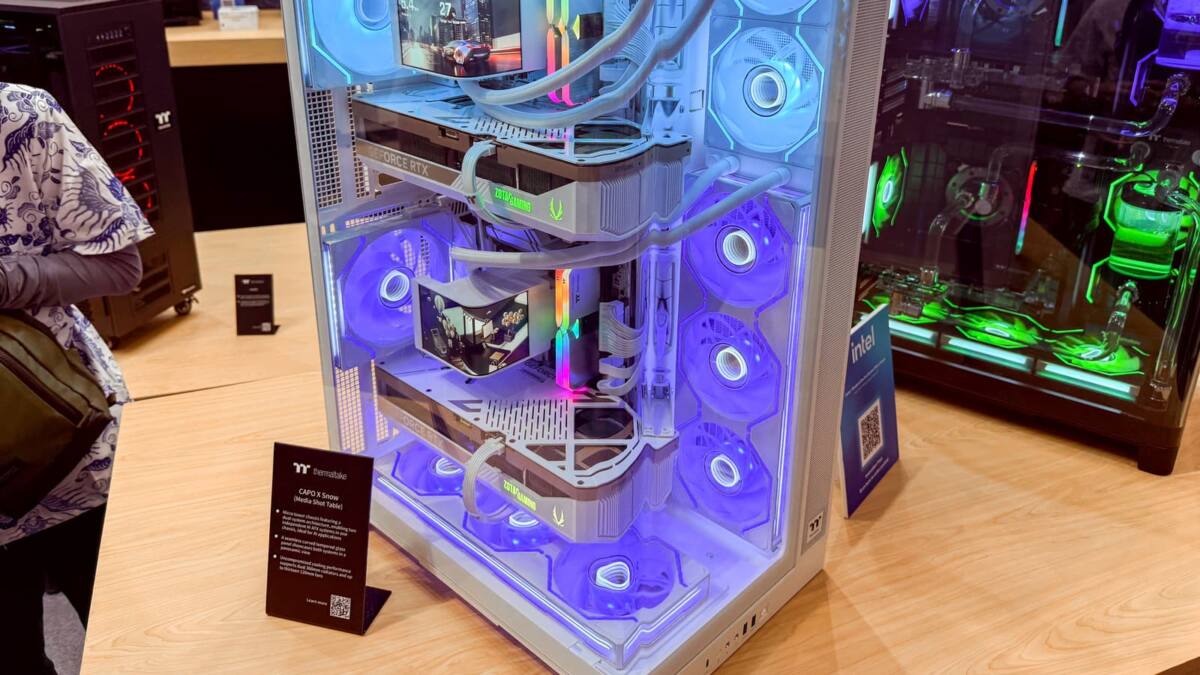
Thermaltake used Computex 2026 to show a very Thermaltake kind of future: more screens, more power, more cooling, and apparently more computers per box. The headline act is Capo X, a chassis that can hold two independent Micro-ATX systems, each with its own ATX power supply and I/O panel. That makes it a dual-system PC case aimed at creators, streamers, and AI tinkering setups that have outgrown the single-PC playbook.
There’s a clear pattern behind the rest of the booth, too. Thermaltake is leaning into oversized cases and modular hardware at a time when high-end builds are getting hotter, hungrier, and more specialized, while rivals keep pushing cleaner cable management and back-connector boards. Thermaltake is basically saying: fine, but what if we also made room for two systems, 29 fans, or a 3200 W power supply?
Capo X dual-system PC case
Capo X is the strangest and probably the most interesting product in the batch. Thermaltake says the case can house two separate computers on Micro-ATX boards, with each system getting its own power button, reset button, audio jacks, two USB 3.0 Type-A ports, and one USB 3.2 Gen 2 Type-C port. It also supports back-connector motherboards from Asus, MSI, and Gigabyte, and can fit up to 13 120 mm fans plus two 360 mm radiators.
The use cases are obvious enough: one machine for gaming, another for streaming; one for work, another for background jobs; one for testing different operating systems. Thermaltake even calls out local AI workloads, which is a pretty polite way of saying the company expects people to keep stuffing more silicon into the same room.
- Two independent Micro-ATX systems
- Separate ATX power supplies and front panels
- Up to 13 120 mm fans
- Two 360 mm radiators
Thermaltake’s own preview pricing puts Capo X at around $190 on the international market. That is not cheap for a normal case, but for a dual-system chassis it is surprisingly restrained.
AX 1000 TG and AX200 workstation cases
If Capo X is the clever one, AX 1000 TG is the brute. Thermaltake describes it as a giant enclosure for workstations and extreme builds, with support for two systems on boards up to SSI-EEB, two power supplies, up to 29 fans, and two 560 mm radiators. It can also be expanded with the AX200 lower module, which adds more room for storage, cooling, fans, and a PSU.
The company’s target audience here is less ”gaming enthusiast” and more ”person whose desk already has a noise problem.” Orienting the product around AI work, workstation duties, and near-server setups makes sense, because that is where oversized enclosures still have a real job to do.
Thermaltake listed an indicative price of:
- AX 1000 TG: $900
- AX200: $300
Retro cases and a CRT-style cooler
Thermaltake also tried to have some fun. The Retro 260 TG and Retro 360 TG line is aimed at buyers who want modern hardware wrapped in old-school PC styling, complete with front panels that look like they were borrowed from a beige tower that survived the 1990s.
Retro 260 TG is the smaller Micro Tower, built for Mini-ITX and Micro-ATX boards, with room for graphics cards up to 370 mm long, CPU coolers up to 165 mm tall, and power supplies up to 220 mm. Retro 360 TG steps up to ATX support, 400 mm GPUs, 170 mm coolers, and 275 mm PSUs, while also allowing horizontal or vertical GPU mounting.
The retro theme continues in the Retro Ultra ARGB Sync liquid coolers, available in 240 mm and 360 mm versions. Their most obvious party trick is a 3.6-inch display on the pump block shaped like a tiny CRT monitor, showing temperatures, animation, and Thermaltake’s themed visuals. It is pure nostalgia bait, but at least it is distinctive.
DockPower, AX 3200W and Swafan EX Infinity
Thermaltake’s DockPower power supplies are more practical than flashy. The PSU body is split from a removable dock module where the cables connect, which means replacements or maintenance should be less painful for anyone who has ever untangled a fully built system and questioned their life choices. The line spans 750 W, 850 W, 1000 W, and 1200 W models in black and white, all with 80 Plus Gold certification and fully modular cabling.
For workstation-class builds, the company also showed AX 3200W, a 3200 W PSU with 80 Plus Platinum certification, ATX 3.1 support, and multiple 12V-2×6 connectors for graphics cards. That is the sort of number that makes even high-end desktop power supplies look underfed.
Swafan 120 EX Infinity and Swafan 140 EX Infinity round out the cooling gear with MagForce 2.0 magnetic connections, hidden screws, and a 28 mm thickness. Their key feature is a removable fan blade assembly, so users can swap in a reverse-flow rotor instead of flipping the whole fan and losing the look of the lighting.
Thermaltake also showed VF360 ARGB Sync, a liquid cooler with an extra fan on the pump block aimed at the area around the CPU socket. The pitch is simple: liquid cooling can leave motherboard power delivery with less airflow than a tower cooler would provide, so this little fan tries to patch the gap. Whether the payoff is measurable will depend on testing, not marketing slides.
GR900 and GR700 sim racing cockpits
Thermaltake also had its eye on sim racing, with the GR900 and GR700 cockpit frames. GR900 is the bigger platform, built from aluminum profile and steel parts, with modular construction, pedal and wheel-base adjustment, support for F1 and GT-style seats, and compatibility with Thermaltake accessories as well as gear from Logitech, Fanatec and Thrustmaster.
GR700 is simpler, but it is still meant for high-torque wheel bases and adjustable seating, with support for extra stands, seats, and motion setups. The line makes the same argument as Thermaltake’s PC hardware: if you are going to build a heavy-duty setup, you may as well build one that can survive the next upgrade cycle.
The open question is whether buyers want more modularity, more scale, or just less clutter. Thermaltake is betting that the answer is ”all three,” and judging by this booth, it is not being subtle about it.