

BYD is moving past car sales and into charging infrastructure with a €2 billion plan to build a Europe-wide network of Flash Charging stations, starting with live sites in Germany and the United Kingdom. The headline claim is hard to ignore: each stall can deliver up to 1.5 MW through a single connector, far beyond the current pace set by mainstream fast chargers, and it gives BYD another lever to pull as it pushes premium and mass-market EVs deeper into Europe.
The first public stations went online this month, and the company says the system is designed to match its second-generation Blade battery and Super e-Platform architecture. For compatible 800V+ vehicles, BYD says charging from 10% to 70% takes about 5 minutes, while a 10% to 97% top-up takes 9 minutes. That is not a typo, and it is also the sort of number that makes older charging hubs look like yesterday’s hardware.
BYD Flash Charging leaves Tesla chasing wattage
On paper, BYD’s network is significantly more powerful than Tesla’s current European benchmark. Tesla’s newest Supercharger V4 stations can deliver up to 500 kW, while Supercharger V3 tops out at 250 kW. BYD says a 5-minute session can add about 400 km of range for supported vehicles, which is exactly the kind of figure that turns charging from a coffee break into a stopwatch race.
- BYD Flash Charging: up to 1.5 MW per connector
- Tesla Supercharger V4: up to 500 kW
- Tesla Supercharger V3: up to 250 kW
Europe and the UK get the first stations
BYD plans to install 3,000 Flash Charging stations across Europe by the end of 2026, including 300 in the United Kingdom. The rollout will happen both at Denza dealerships and on third-party sites, which is the sensible part of the strategy: drivers do not care who owns the concrete, only that the cable works. First buyers of BYD cars in the UK will also get 18 months of free charging.
The company is not limiting the technology to halo models forever, either. It plans to bring support to all lower-range EVs in its lineup in the UK and Europe over the next few years, which is how a charging network stops being a showcase and starts becoming a sales tool. That matters because charging access is still one of the biggest reasons buyers hesitate to leave familiar brands behind.
BYD’s market share is already rising
The timing is not accidental. According to ACEA, BYD’s market share in the EU rose from 0.8% to 1.9% in the first four months of 2026, while in the UK it reached 3.4%, ahead of Renault and Volvo Cars. That kind of growth suggests BYD is trying to do in Europe what Tesla once did with the Supercharger network: make the ecosystem itself part of the buying decision.
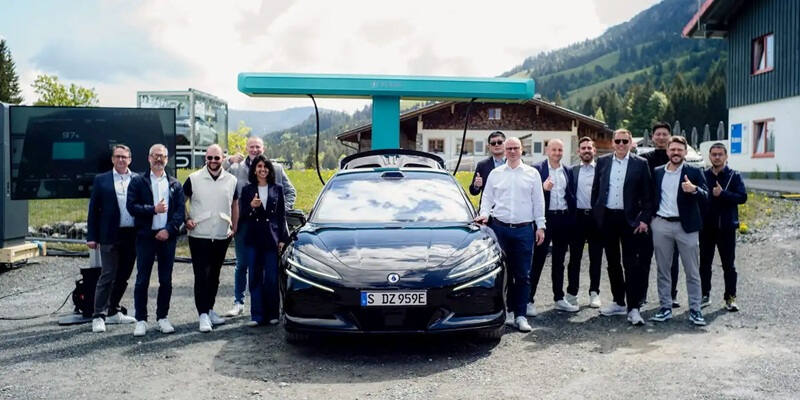
Denza Z9 GT, one of the first premium EVs BYD is offering in Europe, already supports the new system and can be charged almost fully in 12 minutes even at temperatures down to -30 °C. The open question is how quickly rivals respond, because a network this fast does not stay a marketing line for long before competitors are forced to answer with their own plug-and-power arms race.