

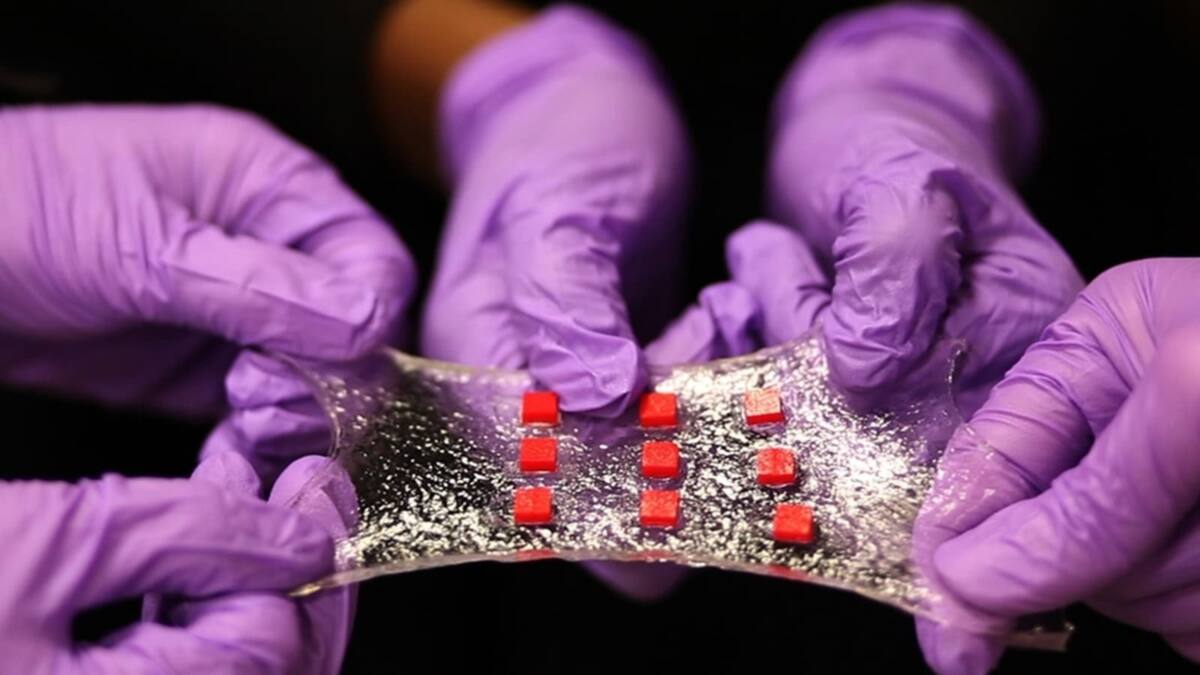
South Korean researchers say they have built a hydrogel electrolyte that could finally make flexible batteries useful outside the lab. The material stretches to nine times its original length, keeps ion transport going at up to -20 °C, and helped energy cells retain about 98% of their initial capacity after 45,000 charge and discharge cycles.
The work comes from Sungkyunkwan University (SKKU) and targets two of the ugliest problems in flexible electronics: batteries that crack under stress and batteries that sulk in the cold. That combination has held back everything from smart clothing to health monitors, because a bendy display is pointless if the power source gives up after a few twists.
A hydrogel that survives bending and frost
Traditional hydrogel electrolytes are attractive because they conduct well and can flex, but they usually depend on water that freezes and performance that fades fast. The new material uses liquid-metal particles produced by ultrasonic fragmentation, which start the polymerization reaction without the heating or ultraviolet light normally used in production. That is a simpler route, and simplicity is often what gets a clever material out of the paper and into a factory.
Researchers also added stearyl methacrylate to build reversible links between polymer chains. Those links separate under strain and then reconnect after the load is removed, which is how the hydrogel can tolerate 900% elongation without falling apart. A lithium chloride treatment then lowers the freezing point of the water inside the material, preserving flexibility and ionic conductivity in subzero conditions.
Flexible batteries tested for long-term durability
The headline number is the cycle count. After 45,000 charge-discharge cycles, the energy storage devices built on the hydrogel still held roughly 98% of their original capacity. That is the sort of durability manufacturers of wearables love to hear, because consumers already complain when a smartwatch battery gets tired after a year, let alone after repeated bending.
- Stretchability: 900% of original length
- Operating temperature: down to -20 °C
- Capacity retained: about 98% after 45,000 cycles
Wearables are the obvious target
SKKU’s team says the technology could underpin the next wave of flexible batteries for smart watches, medical sensors, electronic textiles and other worn-on-body devices. The market already has plenty of flexible screens and soft sensors; power storage has been the laggard, and that is where this kind of material could do the most damage to the status quo.
The open question is scale. The chemistry looks promising, but the real test is whether a material that behaves this well on the bench can be manufactured consistently, cheaply, and without losing its best traits on the way to production lines.