

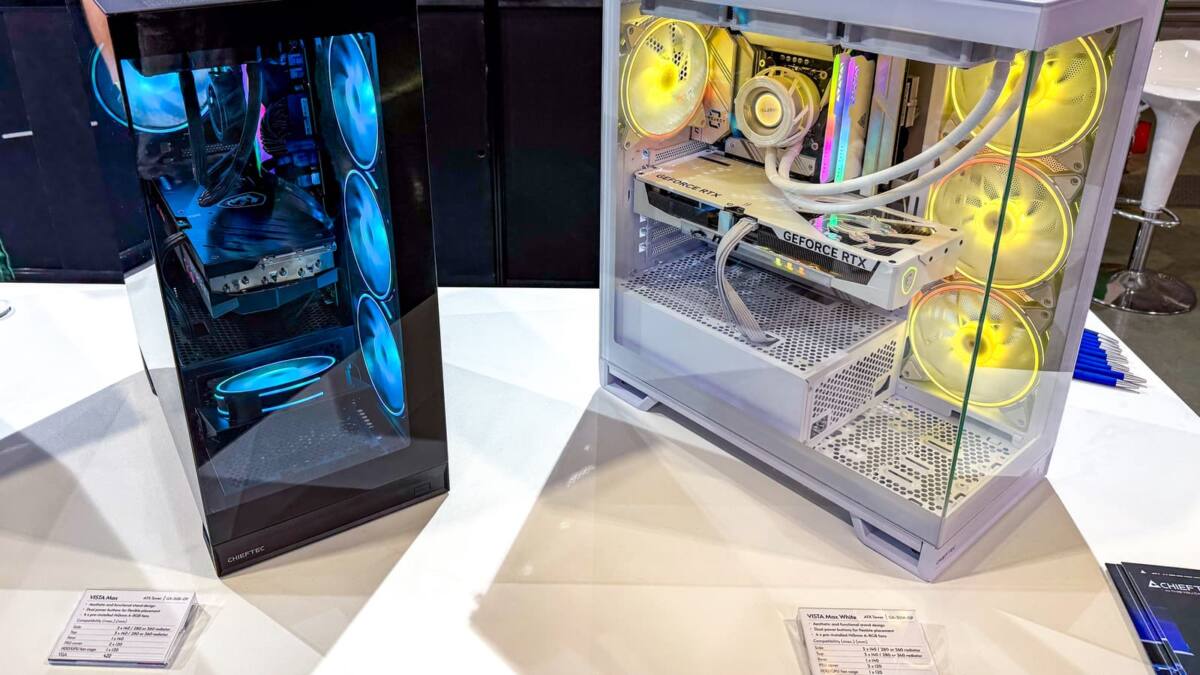
Chieftec used Computex 2026 to show two very different cases aimed at two very different buyers: the Vista Max (GX-30B-OP), a glass-heavy ATX tower for flashy builds, and The Big One (BA-30B-OP), an E-ATX tower built for serious multi-card systems. One is meant to show off, the other to hold a lot of hardware without flinching, and Chieftec clearly knows those are not the same audience.
The lineup also says something about where PC case design is drifting: more airflow, more preinstalled fans, and more room for oversized GPUs that now behave like small appliances. That trend is not unique to Chieftec, but it does explain why case makers keep stretching layouts instead of just polishing old ones.
Chieftec Vista Max adds ARGB fans and dual power buttons
Chieftec’s Vista Max is basically a larger version of the existing Vista, and the extras are aimed squarely at builders who want the case to look finished straight out of the box. Chieftec includes four 140 mm ARGB fans, plus two synchronized power buttons – one on the front and one on the top panel.
Cooling support goes beyond the obvious fan mounts. The case also adds a front-lower mounting point with an adjustable angle, which is the sort of detail that sounds small until you are trying to tame a hot GPU and a warm glass-sided enclosure at the same time. Graphics cards up to 420 mm long are supported.
The Big One supports E-ATX and five PCIe cards
The Big One takes the opposite approach. It supports E-ATX motherboards, offers eight expansion slots for up to five PCIe cards, and keeps the focus on workstations and server-style configurations rather than RGB theatrics.
It still allows graphics cards up to 420 mm long, and Chieftec adds a vertical support bracket for the GPU, which is a sensible nod to the sag problem that comes with today’s chunkier cards. A rear exhaust fan is also included, although it blocks the video card connectors, so cable planning is going to matter more than the marketing gloss suggests.
Chieftec says The Big One will cost about 150 euro. That is not cheap, but for a chassis that can swallow serious expansion hardware, it sits in the realm of expected rather than outrageous. The bigger question is whether buyers building around one giant GPU will still care about all those extra slots, or whether this kind of case is really for the shrinking group that still needs several cards at once.