

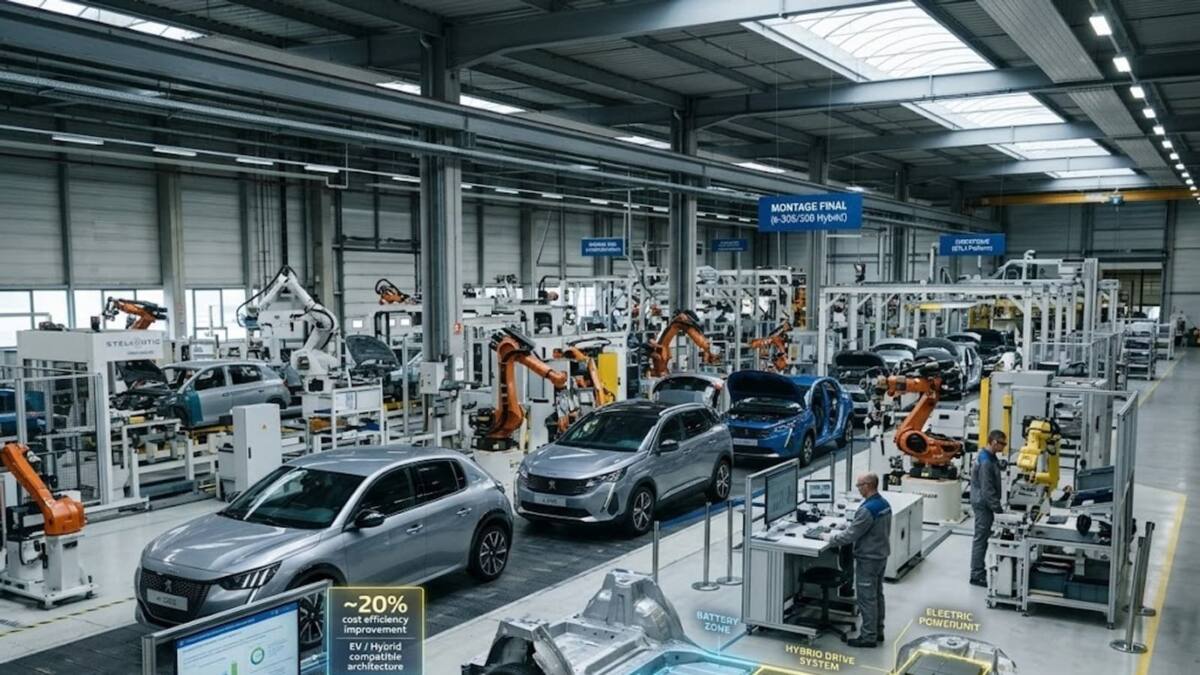
Stellantis is committing more than €1 billion to France to prepare three future Peugeot models on its new STLA One platform, with production set to begin in 2029 at the Mulhouse plant in Alsace. The move will help Stellantis build the next wave of electrified Peugeot models closer to one of Europe’s fiercest battlegrounds, while aiming to manufacture them more cheaply and at higher volume than the current generation.
For Stellantis, this is also a signal of where it wants Peugeot to sit inside the group: not as a nostalgic French badge, but as a core profit engine. That matters because Peugeot competes in the C-segment, which the company says makes up about 30% of the passenger-car market in Europe, the kind of volume-heavy territory where margins are won or lost on platform efficiency and pricing discipline.
Mulhouse gets the first STLA One Peugeot models
The Mulhouse site, which currently employs about 4,500 people, will become the main manufacturing base for the three Peugeot models. Stellantis says the move will help improve factory utilization and strengthen the plant’s long-term prospects as the auto industry shifts toward electrification.
That is the unglamorous part of the story, but probably the most important one. Carmakers keep talking about transformation; plants need actual cars on the line. In Europe, where overcapacity and tight competition have already squeezed several manufacturers, keeping a major factory busy is almost as valuable as launching a new model.
STLA One is built for scale, not theatrics
STLA One is a modular, scalable architecture designed for multiple vehicle classes and powertrains, including fully electric and hybrid versions. Stellantis says the shared approach should shorten development cycles and cut costs by about 20% through component commonality and scale effects.
That cost claim is the part rivals will be watching closely. Platform sharing is hardly new – Volkswagen, Renault, and Hyundai have all leaned hard on it – but the payoff only shows up if the company can keep the architecture flexible without making every car feel like a trim-level exercise in disguise.
- Investment: more than €1 billion
- Plant: Mulhouse, Alsace
- First production: 2029
- Platform: STLA One
- Models: three future Peugeot vehicles
France keeps its place in Stellantis’ Europe plan
Stellantis also pointed to French industrial policy, including support for cleaner vehicles and the broader ”Made in Europe” push, as part of the backdrop for the investment. That is a familiar pattern across the continent: governments want local jobs and cleaner transport, automakers want subsidies and a predictable regulatory climate, and everyone pretends this is a perfectly natural alignment.
Chief executive Antonio Filosa framed the decision as a vote of confidence in the company’s manufacturing base and France’s role in Stellantis’ global network. The real test will come in 2029, when the first STLA One-based Peugeot models are supposed to roll out and prove that a big factory investment can still be a smart answer to a market that is becoming more electric, more crowded, and less forgiving.