

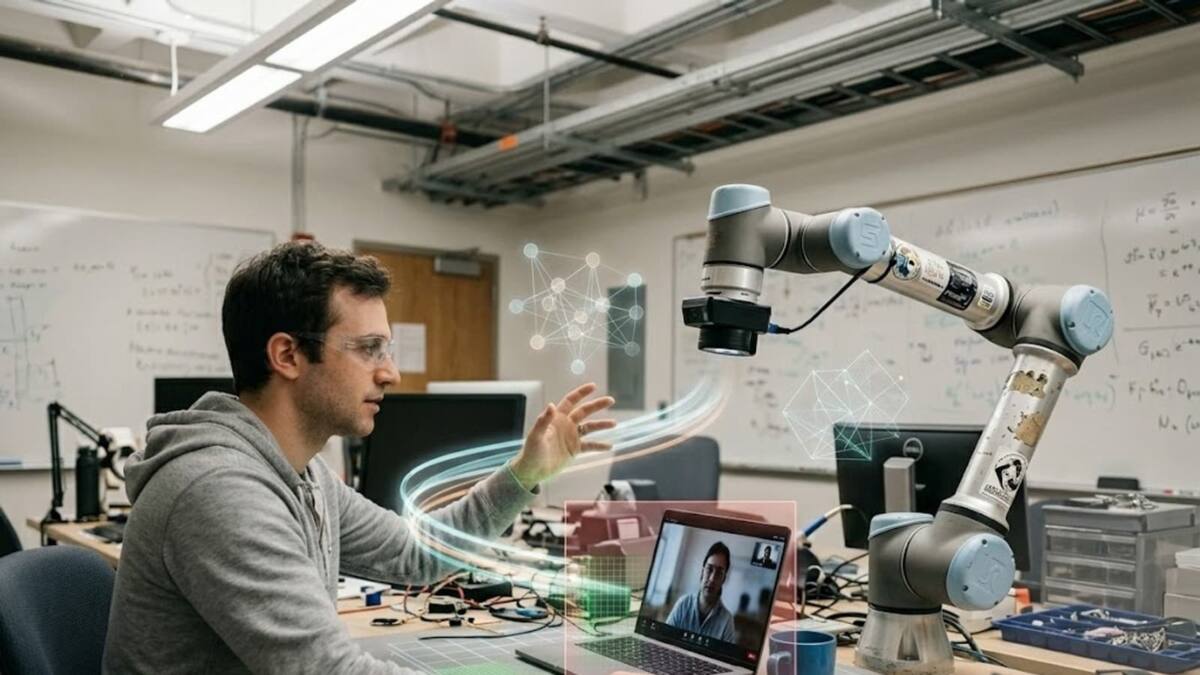
MIT researchers have built a robot training method that does something surprisingly human: it picks up on what people mean, not just what they say. The system, called Masked Inverse Reinforcement Learning, cuts the amount of demonstration data needed by almost five times and makes robots better at spotting the preferences people forget to spell out.
That matters because most instructions are incomplete by design. Ask a robot to hand over coffee during a video call, and nobody usually says ”avoid the laptop, don’t lean into my face, and try not to be creepy.” Yet those unwritten rules are often the real task.
How Masked IRL filters out the noise
The method uses a two-step process. First, one language model studies a human demonstration and turns vague guidance into a more precise instruction. Second, another model looks at the environment and labels objects as relevant or irrelevant, so stray behavior does not get mistaken for intent.
MIT’s example is telling: if a person happens to rest a hand on a table while showing a task, the system can ignore that as incidental. But a laptop, a barrier, or the target object itself gets flagged as important. That sort of triage is exactly what many robot systems have lacked, which is why they often perform like overconfident interns.
- Almost 5x fewer demonstrations needed than existing methods
- 15% better at identifying hidden user preferences in tests
- Works in both simulation and on a real robotic arm
The robot learned the difference between a laptop and a target
In practical trials, a robot trained on 50 physical demonstrations learned to pass objects to a person while keeping clear of a nearby laptop, which it had learned to treat as something to avoid. In other tests, it wiped a table while staying close to the surface, and it handed over a bag of chips without drifting into the person or the table beside them.
That is the real win here: less training, fewer awkward collisions, and behavior that looks more considerate. In a field where many systems still need piles of examples to get simple tasks right, shaving down the data requirement is a practical advantage, not just a neat lab trick.
Computer vision is the next step for Masked IRL
For now, the system relies mainly on sensor data and motion information. The researchers want to add computer vision next, so robots can identify useful objects before they even start moving. If a robot is told to pick up a toy, it should be able to ignore the bananas nearby without being explicitly warned, which feels almost suspiciously sensible.
The work is slated for presentation at IEEE International Conference on Robotics and Automation (ICRA 2026) in June in Vienna. If the approach holds up outside the lab, it could be useful anywhere humans and machines share tight spaces: homes, warehouses, factories, and offices, where robots increasingly need to behave less like machines and more like well-trained guests.