

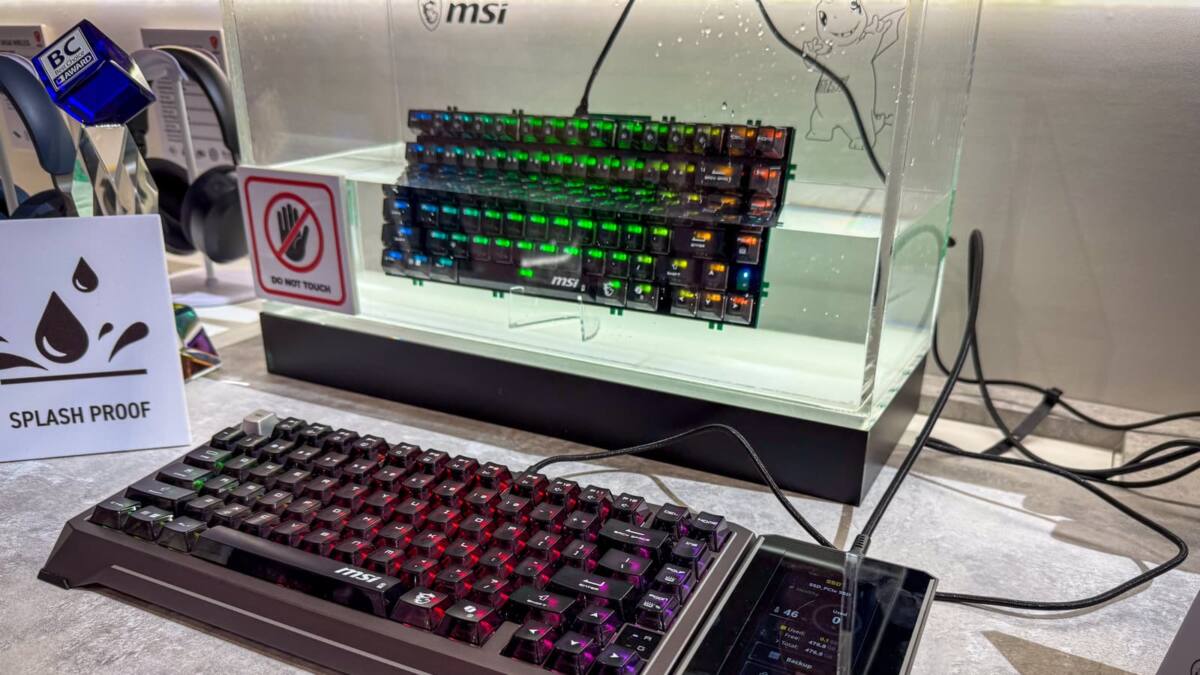
MSI has shown off a keyboard combo that is doing two jobs at once: the Strike Alloy TMR brings magnetic switches and a very fast polling rate, while the Strike Nexus turns into a detachable control pad, a tiny status display, and even an external M.2 SSD enclosure. It is the kind of crossover product that looks slightly overengineered until you remember how many people keep buying gadgets to save one USB port and a little desk space.
The pair debuted at Computex 2026, and the headline feature is flexibility. MSI is clearly chasing gamers and power users who want one device that can handle key actuation tuning, lighting control, and storage expansion without turning the desktop into a cable museum.
Strike Alloy TMR specifications
Strike Alloy TMR uses TMR sensors, supports polling rates up to 8000 Hz, and offers precise adjustment of the actuation point. MSI says the board works over wired, 2.4 GHz, and Bluetooth 5.3 connections. The case is made from a magnesium-aluminum alloy, and the design is said to be compatible with both magnetic and standard mechanical switches.
- TMR sensor-based switches
- Polling rate up to 8000 Hz
- Wired, 2.4 GHz, and Bluetooth 5.3 connectivity
- Magnesium-aluminum alloy body
- Compatible with magnetic and mechanical switches
What Strike Nexus adds to the setup
Strike Nexus is the more unusual half of the package. It attaches to the keyboard with magnets and includes a 4.3-inch touchscreen that can launch apps, control RGB lighting, show system information, and function as a numpad. That is a lot of utility for a module that also doubles as storage hardware.
On the back, MSI has placed an M.2 slot for an SSD with encryption support, unlocked after entering a numeric code on the touchscreen. The module connects over USB-C at 10 Gbit/s, which should keep it from feeling like a novelty with a dongle attached.
Strike Alloy TMR and Strike Nexus pricing and release
MSI has not said how much the Strike Alloy TMR and Strike Nexus will cost, when they will ship, or whether buyers will be able to purchase them separately or only as a bundle. That omission matters more than usual here: flashy accessory ecosystems tend to look brilliant on stage and suddenly sensible only if the pricing does not drift into premium-laptop territory.
For now, the pitch is obvious. MSI wants to make the keyboard the center of the desktop again, while rivals keep pushing simpler hall-effect boards and software-heavy control surfaces of their own. Whether buyers want the extra screen or just the switches will decide how far this idea goes.