

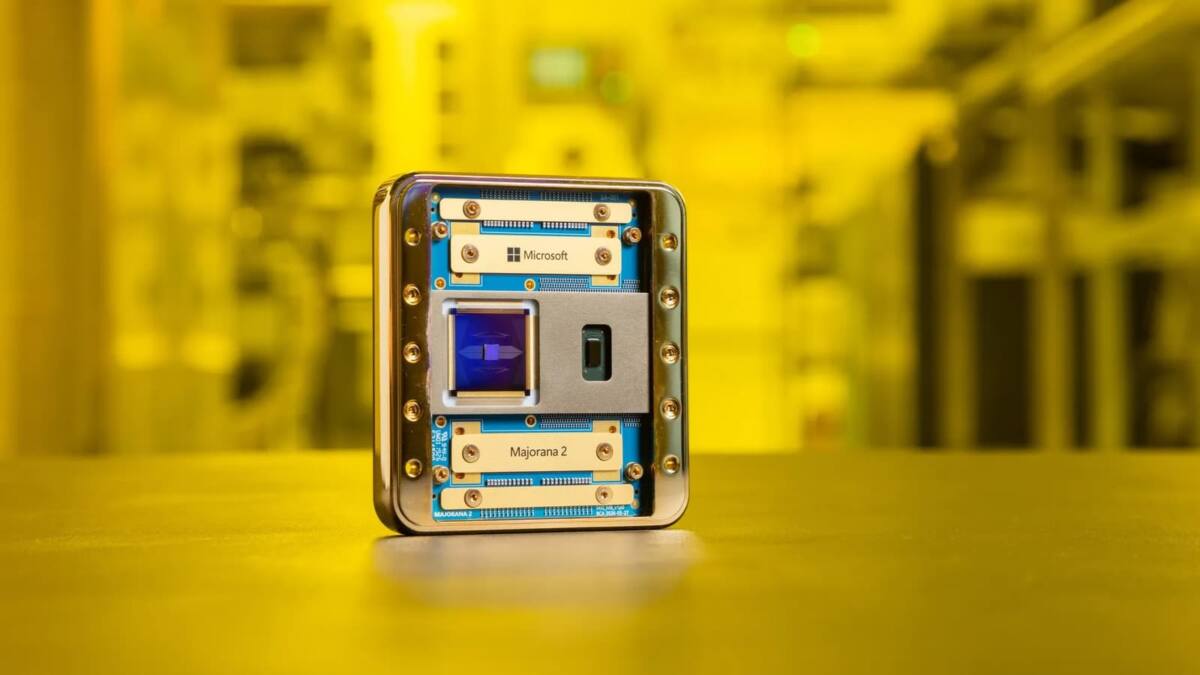
Microsoft has shown off Majorana 2, its next quantum processor, and the headline claim is hard to ignore: the company says its qubits are now 1000 times more reliable than in Majorana 1. The chip, unveiled at Build in San Francisco, also reflects a bigger bet – that quantum hardware and agentic AI can be built together, not in separate silos.
The new processor follows Microsoft’s first Majorana chip, which leaned on exotic states of matter that had long divided researchers. This time, the company says it has changed both the materials stack and the architecture in ways that improve stability and reduce the sort of interference that keeps quantum systems fragile. That is the sort of boring-sounding engineering work that determines whether quantum computing stays a lab demo or becomes something businesses can actually use.
What changed in Majorana 2
Microsoft Quantum corporate vice president and technical fellow Chetan Nayak said the team refined the materials used in Majorana 1 to create a more stable topological phase. In Majorana 2, aluminum as the superconductor was replaced with lead, while the semiconductor active area was updated to a combination of indium arsenide and indium arsenide antimonide.
That matters because quantum bits are notoriously sensitive to outside noise, from electromagnetic interference to cosmic radiation. Microsoft says the new setup protects qubits better, and the numbers it shared are more than a modest tweak: average stable runtime is now 20 seconds, while some qubits held steady for up to one minute in individual experiments.
- Reliability: 1000 times higher than Majorana 1
- Average stable operation: 20 seconds
- Best reported stability in experiments: up to one minute
Microsoft’s quantum timeline just got shorter
Microsoft says the progress was enough to pull its roadmap forward. The company says it has cut its timetable in half and now aims to reach a scalable, practical quantum computer by 2029. That is an ambitious target, but also a useful reminder that the race is not only against rivals – it is against physics, error rates, and the long list of things that can go wrong when qubits breathe on their own.
If Microsoft gets there, the payoff would be the ability to tackle problems that still sit beyond the reach of even the most powerful supercomputers. If it does not, Majorana 2 will still matter as a marker of how far the company has pushed a once-theoretical approach toward something more tangible.
Discovery is now public too
Alongside the chip announcement, Microsoft also opened up its Discovery platform. The agentic AI system helped engineers design Majorana 2 and simulate different hardware options, and the company says it is aimed at research and advanced development across science and engineering.
That pairing is the real story here. Quantum computing still needs a lot of time and patience, but Microsoft is trying to shorten the cycle by using AI to speed up the materials and design work around it. Rival labs are chasing the same prize from different angles, but this combined approach gives Microsoft a cleaner narrative: use AI to build better quantum machines, then use those machines to solve harder problems.
What to watch next
The obvious question is whether the gains hold up outside Microsoft’s own experiments. The less obvious one is whether the company’s newly compressed schedule survives contact with reality. For now, Majorana 2 is a strong signal that Microsoft wants to move from quantum promise to quantum product – and it wants AI to help drag it there faster.