

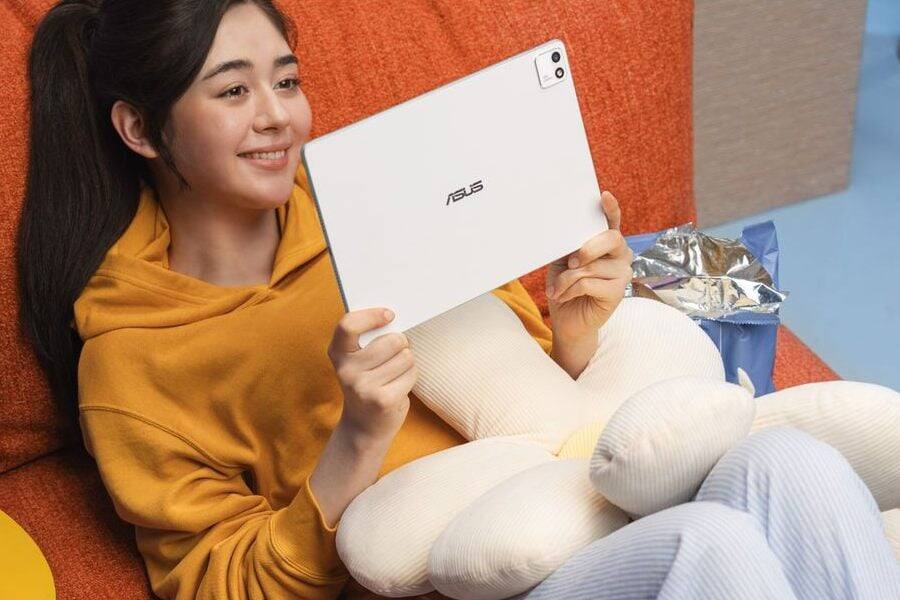
Asus is back in the tablet business with the new Asus Pad, a mainstream slate built around a 12.2-inch tandem OLED screen, MediaTek’s Dimensity 8300 chip, and Android 16. The Asus Pad stands out with a tandem OLED tablet display that aims to improve brightness, power efficiency, and panel lifespan. The timing is a little awkward in the best possible way: the company has just waved goodbye to phones, but it is clearly not done chasing portable screens. In a tablet market where Apple and Samsung tend to grab the loudest headlines, Asus is betting that display quality, battery life, and a few productivity extras are enough to make people look twice.
The headline feature is the dual-layer OLED panel. Asus says the setup improves brightness, power efficiency, and panel lifespan by stacking two OLED emission layers, while still delivering 2.8K resolution, a 144Hz refresh rate, 100% DCI-P3 coverage, and up to 600 nits of typical brightness. That is a tidy spec sheet, and it puts the Asus Pad squarely in the premium-display conversation rather than the bargain-bin tablet aisle.
Asus Pad display and design
The 12.2-inch panel is doing most of the heavy lifting here. Tandem OLED is still relatively rare in tablets, and Asus is leaning hard on the pitch that two emission layers are better than one for both longevity and efficiency. Competitors have spent years talking up brighter LCDs and mini-LED backlights; Asus is taking the simpler route and saying, basically, ”just give people a better OLED.”
At 6.5mm thin and 523 grams, the Asus Pad is not exactly featherweight, but it stays in the comfortable zone for a large-screen tablet. The magnesium chassis and fiberglass back cover should help it feel more premium than the average plastic slab, and probably less disposable too.
Dimensity 8300, storage and battery
Inside, Asus goes with MediaTek’s Dimensity 8300, built on a 4nm process, alongside 8GB of LPDDR5X RAM and up to 256GB of UFS 3.1 storage. There is also a microSD slot that supports cards up to 1TB, which is the kind of practical detail Samsung used to make famous and too many rivals now treat like a relic.
- Display: 12.2-inch tandem OLED, 2800 x 1840, 144Hz
- Chipset: MediaTek Dimensity 8300
- Memory: 8GB LPDDR5X
- Storage: up to 256GB UFS 3.1, plus microSD up to 1TB
- Battery: 9,000mAh with 45W USB-C charging
The 9,000mAh battery is paired with 45W USB-C charging, and Asus says it can hit 50% in about 30 minutes. That kind of claim is becoming table stakes in premium Android hardware, but it still matters because tablets are far less forgiving than phones once they run out of juice. A big screen with a fast refresh rate can chew through power quickly if the tuning is sloppy.
Android 16 and the productivity push
Asus is also packing the software side with familiar Google tools and its own cross-device pitch. The Asus Pad runs Android 16, supports Circle to Search and Google Gemini, and includes GlideX for screen sharing, file transfers, and workflows across compatible devices. Asus Pen 2.0 support and Bluetooth keyboard connectivity make the company’s intent plain: this is meant to be a tablet you can actually use for more than doomscrolling and streaming.
The rest of the hardware rounds things out without getting flashy. There is Wi-Fi 6E, Bluetooth 5.3, Face Login, a 13MP rear camera, a 5MP front camera, and a quad-speaker system with Dolby Atmos. The audio setup should help the tablet feel more complete for video and gaming, which is important because tablets often live or die by how convincing they are as living-room devices first and productivity tools second.
Asus has not exactly picked the easiest time to re-enter the segment, but there is a logic to it. The tablet market has stabilized around a few big players, yet there is still room for brands that can make a strong hardware argument instead of trying to win on software ecosystems alone. The Asus Pad looks like a direct attempt to do that, and the display is the strongest card in the deck.
The bigger question is whether Asus can keep the follow-through going. A sharp panel and decent specs are a good opening move, but the real test will be pricing, availability, and whether this is the start of a longer tablet push rather than another brief cameo.