

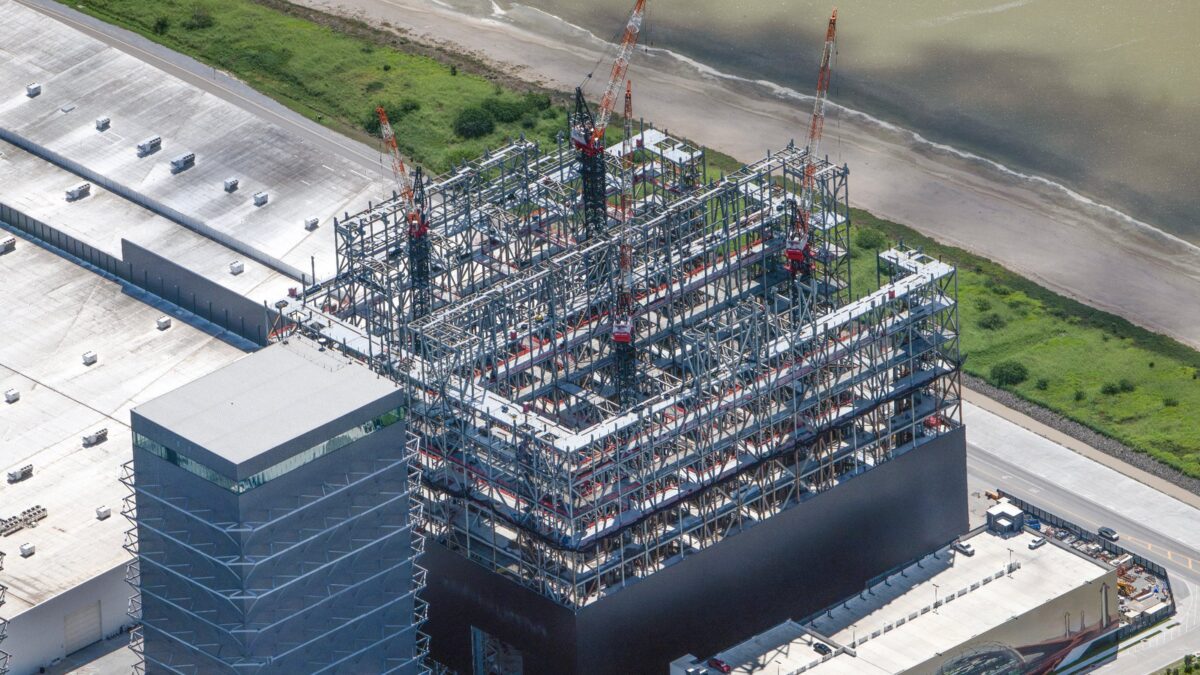
SpaceX’s giant new Gigabay at Starbase is no longer just a render and a promise. Fresh aerial photos show a multilevel steel shell rising fast in Texas, with cranes active, exterior panels going up, and the existing Megabay still handling Starship assembly nearby.
The Gigabay at Starbase is designed to speed up production of Starship and Super Heavy, with SpaceX aiming for a building big enough to support far higher output. If the company hits its target, it will be a major answer to the bottleneck that follows ambitious launch cadence plans: build more hardware, faster, in a place designed to swallow rocket-sized problems whole.
Gigabay dimensions and production target
The numbers are already eye-watering. Gigabay is expected to stand 116 m tall, stretch 110 m long, and 130 m wide, with a usable internal height of up to 115 m. SpaceX has also described around 75,700 sq. m of working space and roughly 1.3 million cu. m of internal volume, which should let it hold several Starship vehicles at once.
- Height: 116 m
- Length: 110 m
- Width: 130 m
- Useful internal height: up to 115 m
- Working area: about 75,700 sq. m
- Internal volume: about 1.3 million cu. m
Elon Musk has said the building is designed for 1,000 Starship vehicles a year. That is the sort of number that sounds inflated until you remember SpaceX keeps trying to turn rocket production into something closer to car manufacturing, only with more heat shields and fewer cup holders.
What the Starbase photos show
The latest images, credited to RGV Aerial Photography, show the structure well beyond the foundation stage. The steel frame is clearly visible from above, the outer walls are being clad, and heavy construction equipment is still busy around the site. In other words, this is no longer a moonshot mood board; it is a real factory taking form.
Gigabay is supposed to become the new center of production for Starship and Super Heavy, and SpaceX says it aims to finish construction in 2026. That timeline will matter: SpaceX has already been moving quickly on Starbase infrastructure, and a dedicated mega-factory would help it escape the limits of smaller assembly spaces that can only push so many giant rockets through at once.
Why SpaceX wants a bigger factory now
SpaceX carried out 5 test launches of the Starship system in 2025, but it has not officially said how many rockets were assembled in its Starfactory hangars over the year. That silence leaves plenty of room for interpretation, though the construction boom suggests the company is betting that launch rate, not just launch success, will decide the next phase of the program.
There is also a broader pattern here. Rocket builders have long been constrained by clean-room-style workflows and limited indoor space, while SpaceX keeps trying to brute-force scale. Boeing and ULA have spent years proving that conventional aerospace production moves slowly; SpaceX is now trying to prove the opposite with one gargantuan building and a very large ambition.
Starbase is getting crowded
Gigabay is being built beside Megabay, where rockets are already assembled, and the proximity says a lot about SpaceX’s operating style: build the next constraint before the current one becomes unbearable. The risk, of course, is that a giant building does not automatically solve manufacturing complexity, especially when the vehicles inside are still evolving after each flight test.
That is why the next question is less about whether Gigabay gets finished than whether it actually helps SpaceX sustain a much higher production tempo. If it does, Starbase could become the clearest sign yet that the company is trying to industrialize deep-space hardware at scale rather than just launch it.