

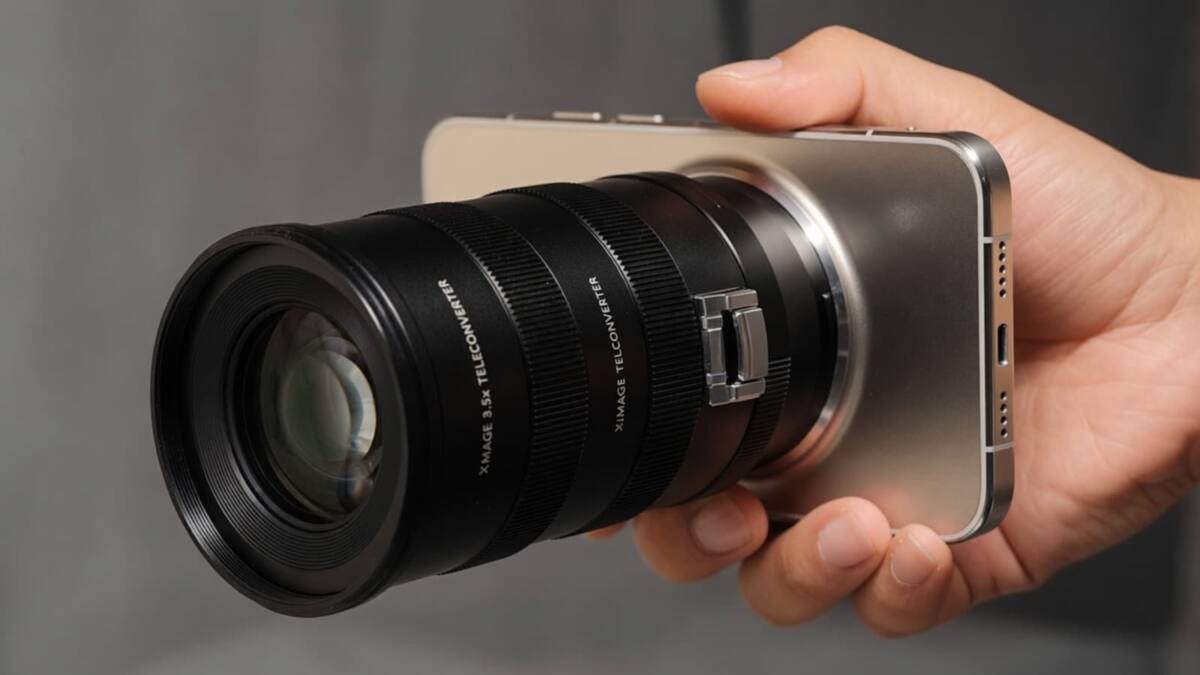
Huawei’s next Mate 90 phones may lean harder into serious zoom photography with external teleconverters, according to a new leak. If the tip is accurate, the company is preparing accessories that attach to the camera and extend optical reach instead of faking it with software – a much more interesting move than the usual ”AI zoom” hand-waving.
The Huawei Mate 90 teleconverters could give the phones cleaner shots of concerts, sports, and distant landscapes, since a teleconverter changes focal length optically rather than relying on digital enlargement. That should preserve more detail when the subject is far away.
What Huawei is said to be building
The leak comes from Fixed Focus Digital, which says Huawei is working on updated solutions for expanding optical zoom. The accessories are described as external modules for the camera system, designed to boost telephoto performance rather than replace it. That puts Huawei in familiar territory for anyone who remembers older smartphone camera add-ons, but the timing is more ambitious now that camera hardware on flagships has become one of the few areas where brands can still brag without blushing.
Huawei would not be the first company to try this approach. Vivo has previously sold similar solutions, and accessory-based imaging has also shown up in other forms across the industry, from clip-on lenses to modular camera experiments. The difference here is that Huawei appears to be aiming at a premium flagship audience that will tolerate bulk if the payoff is better shots.
Huawei Mate 90 teleconverters and optical zoom
Digital zoom can be useful, but it is still a crop, and crops have a nasty habit of exposing every weakness in the sensor and processing pipeline. Optical teleconverters work by physically altering the focal length, which is why they can deliver a more convincing image when the subject is far away and the light is not cooperating.
- Better detail on distant subjects
- More usable zoom for events and travel
- Less reliance on aggressive digital enhancement
That does not mean Huawei is solving every camera problem with one accessory. Added lenses can mean extra cost, extra parts to carry, and a bit more faff than most phone buyers want. But for a brand chasing the ”best phone camera” crown, a serious optical add-on is at least a real strategy, not a marketing slogan in a trench coat.
Huawei’s camera play could pressure rivals
If Huawei ships this on the Mate 90, expect competitors to watch closely. Smartphone makers have spent years squeezing incremental gains out of periscope lenses and computational photography, but accessory-driven optical zoom could reopen a category many had written off as too niche. The question is whether buyers want a more capable camera or simply a thinner phone – because those two desires are still in a fight to the death.
For now, this remains a leak rather than a launch. Still, it points to a broader shift: premium phones are increasingly trying to win on imaging depth rather than raw megapixels, and Huawei seems ready to take that idea a step further.