

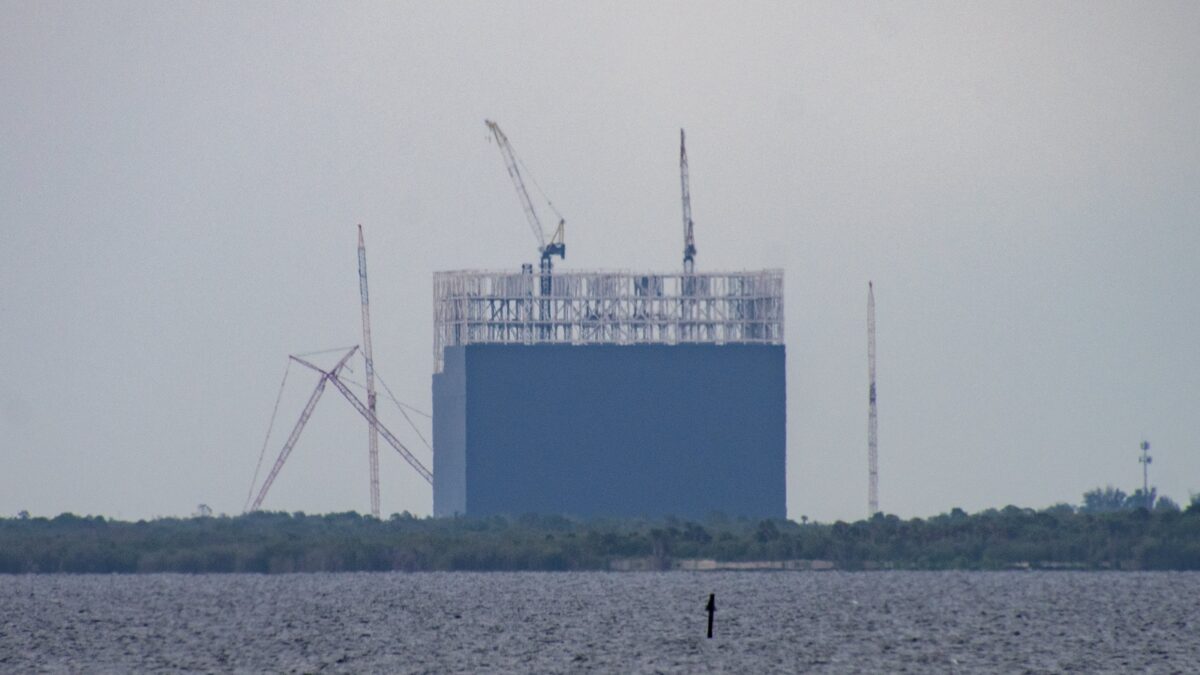
SpaceX’s twin Gigabay factories are no longer just ambitious renderings. Fresh photos from Starbase in Texas and Roberts Road near Cape Canaveral in Florida show the massive Starship assembly buildings rising in parallel, with crews now pushing more of the shell work and exterior cladding into place.
The Texas site is moving fast: four cranes are working there at once, a sign SpaceX is trying to compress a very large build into a very tight schedule. Florida’s Gigabay has gone a little leaner on main cranes, down to two, but is still using extra lifts for upper installation and finishing work. Different tactics, same goal: get both cavernous factories ready for the next phase of Starship production.
Gigabay dimensions and capacity
The published specs are wild even by SpaceX standards. Gigabay is planned to stand 116 m tall, stretch 110 m long and 130 m wide, and offer up to 115 m of usable internal height. The working area is about 75,700 sq. m, with a total internal volume of roughly 1.3 million cu. m, enough to fit multiple Starship vehicles at the same time.
That scale is the point. Starship has already outgrown the normal rhythm of rocket assembly, and SpaceX is building industrial muscle to match Elon Musk’s claim that the facility is designed for ”a thousand Starship in a year.” By comparison, SpaceX carried out five Starship test launches in 2025, which gives you a sense of how far the company still has to stretch its manufacturing pipeline.
How Starbase and Roberts Road are being built differently
The split-screen build tells you a lot about how SpaceX works. Starbase remains the company’s main proving ground, where speed seems to outrank elegance, while Florida is being turned into a second serious production base closer to the launch infrastructure at Cape Canaveral. That second site matters: redundancy is useful when the rocket you want to build is also the rocket you want to launch often.
SpaceX has not publicly broken out how many rockets Starfactory has assembled in a year, which leaves the exact production ramp a little fuzzy. But the direction is clear enough: Gigabay is meant to move Starship from ”impressive prototype” territory toward something closer to mass production, and the company is betting on giant buildings to make that happen by 2026.
Starship production ramps up in 2026
The obvious question is whether SpaceX can turn this concrete-and-steel spectacle into actual throughput. The answer will show up first in how quickly the shell closes up, then in whether the interior can be equipped for concurrent work on multiple vehicles without becoming a traffic jam with better branding. If Gigabay does reach completion in 2026, the bigger story won’t be the building itself. It will be whether SpaceX can finally make Starship feel like a production program instead of a perpetual construction site.