

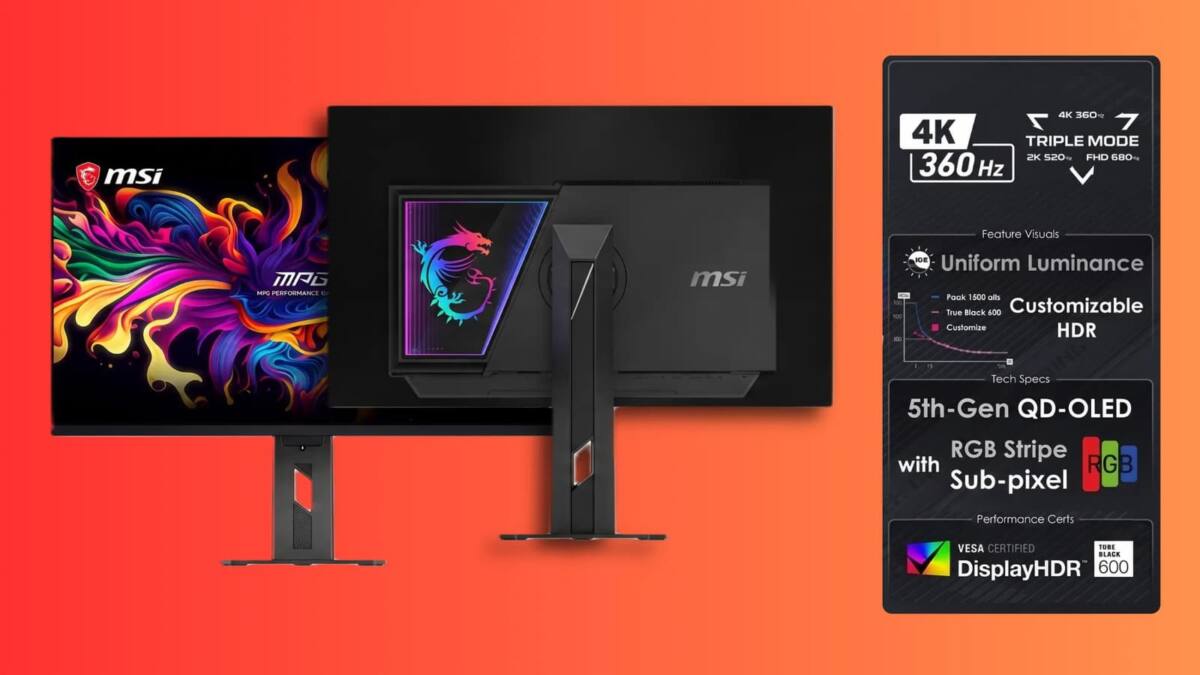
MSI has pulled the cover off the MPG OLED 322URDX36, a 32-inch flagship gaming monitor built around Samsung Display’s latest QD-OLED panel and doing something most rivals still don’t: it can switch between 4K at 360 Hz, 1440p at 520 Hz, and 1080p at 680 Hz. That triple-mode trick is the headline, but the panel tech underneath is just as interesting, because MSI is trying to turn the OLED monitor from ”fast and pretty” into ”fast, pretty, and actually practical for different games.”
The timing is no accident. MSI unveiled the display ahead of Computex 2026, where monitor makers love to one-up each other with absurd refresh rates and brighter panels. The difference here is that MSI is not just chasing bigger numbers; it is also trying to solve a long-standing OLED annoyance: text clarity and brightness limits.
Samsung’s 5th-gen QD-OLED panel
The monitor uses Samsung’s fifth-generation QD-OLED panel, which combines Penta Tandem OLED stacking with a new V-stripe subpixel layout. In plain English, that should mean more brightness and cleaner text, two things OLED monitors have historically struggled to deliver at the same time.
MSI says the panel is the first OLED monitor to meet VESA DisplayHDR 600 True Black requirements. That puts it above the older True Black 500 tier and gives it a peak brightness of 600 nits in a 10% window, 350 nits full screen, and up to 1,500 nits in smaller bright areas. Those are the kinds of numbers that make HDR spec sheets look expensive for a reason.
Three refresh-rate modes instead of two
Most monitors that offer dual-mode switching stick to 4K and 1080p, because those resolutions divide cleanly. MSI’s 1440p mode is the odd one out, since scaling 4K down to 2560×1440 is messier and often softens the image. MSI says it has handled that problem at the hardware level with its scaler, helped by the V-stripe subpixel arrangement.
- 4K at 360 Hz
- 1440p at 520 Hz
- 1080p at 680 Hz
That mix is clever because it gives players three different sweet spots: maximum sharpness for single-player games, a middle ground for competitive titles, and an absurd top-end mode for esports die-hards. Whether 1440p on a 4K OLED actually looks as sharp in practice as MSI claims is the real test, of course. Spec sheets are brave things.
Ports, protection and a few sensible extras
MSI has also fitted the display with DisplayPort 2.1 UHBR20, with up to 80 Gbit/s of bandwidth, plus a USB-C port that can deliver 98 W of Power Delivery. There is the usual OLED burn-in protection package too, backed by a standard 3-year warranty against panel burn-in.
An AI Care Sensor can detect when the user steps away and turn the screen off automatically, which sounds small until you remember how often gaming monitors stay glaring away in empty rooms like they pay rent. MSI did not reveal pricing or availability yet, and those details are expected at Computex 2026. Given how aggressively monitor makers are pushing refresh-rate arms races this cycle, the real question is whether the 1440p mode becomes the feature people talk about, or just the one everyone else copies later.