

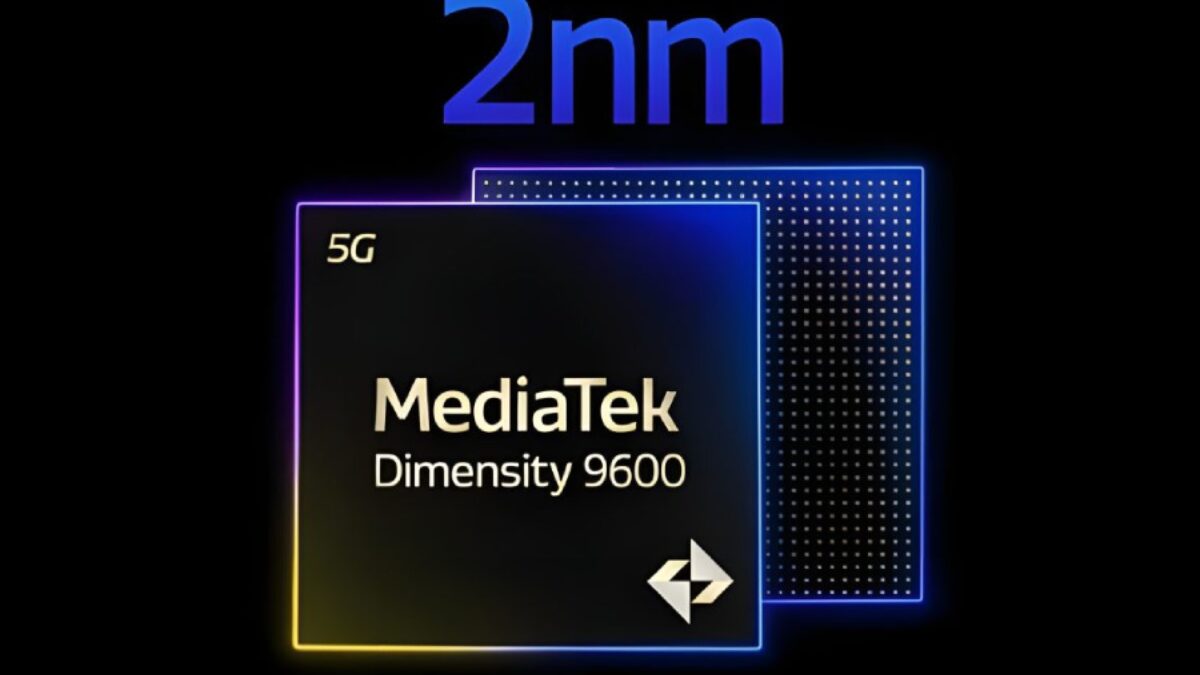
MediaTek’s next flagship chips are still months away, but the shape of the MediaTek Dimensity 9600 family is already coming into focus: a standard model and a more aggressive Dimensity 9600 Pro, both aimed at high-end phones, and both apparently built on TSMC’s 2nm process. The big caveat, of course, is that none of this is official yet, so treat the numbers like a very confident rumor with good shoes.
The more interesting wrinkle is that MediaTek seems ready to split its premium lineup in a way it hasn’t before. If the leaks hold up, the Pro version won’t just be a slightly tuned sibling; it will be the one with the deeper cache of upgrades, while the non-Pro chip may land as the more cost-controlled option for manufacturers that still want flagship silicon without paying for the full fireworks show.
Dimensity 9600 Pro leak details
According to the current rumor stack, the Dimensity 9600 Pro uses TSMC’s 2nm (N2P) node and could bring a 10-15% performance boost alongside a 25-30% improvement in power efficiency compared with the previous generation. The standard Dimensity 9600 may use the same class of silicon, but leaks also leave room for a 3nm version or a lower-binned 2nm part, which is exactly the sort of supply-chain hedge chipmakers love and phone buyers never get to see.
The CPU setup is expected to move away from the old 1+3+4 template. Instead, the Pro chip may use a 2+3+3 layout with two Ultra cores rated at a peak 5.0 GHz, three performance cores, and three balanced performance cores. The standard version may share the same structure, just with a lower peak frequency.
- Dimensity 9600: 2 prime cores, 3 performance cores, 3 efficiency cores
- Dimensity 9600 Pro: 2 prime cores, 3 performance cores, 3 performance cores
- Peak CPU speed: about 4.X GHz on the standard chip, 5.0 GHz on the Pro
- Memory: LPDDR5X on the standard chip, LPDDR6 on the Pro
- Storage: UFS 4.0 on the standard chip, UFS 5.0 on the Pro
Arm Magni GPU and gaming features
Graphics are where MediaTek appears to be swinging for the fences. Both chips are said to use Arm’s next-generation ”Magni” GPU architecture with ray tracing support, while the Pro version may simply pack more cores. More intriguing is the claim that the silicon could handle frame insertion at the hardware level, which would let a 60 FPS game be lifted to 120 FPS or beyond without relying entirely on software tricks.
That kind of feature set is no accident. Qualcomm has been pushing harder on gaming-centric silicon, and Apple’s A-series chips still set the pace for efficiency and sustained performance, so MediaTek’s pitch here is obvious: fewer compromises, faster load times, and smoother visuals in the kind of flagship devices that live or die by benchmark screenshots and game demos.
AI upgrades and Geekbench estimates
The AI side of the story is just as ambitious. Leaks point to a dual-NPU design, a Neural Shader Scheduler that splits tasks between the GPU and NPU in real time, and support for Arm’s Scalable Matrix Extension 2. If that sounds like a lot of alphabet soup, it is – but it’s the sort that should translate into faster on-device AI and better efficiency, which is exactly what phone makers are chasing as they cram more generative features into handheld hardware.
Early Geekbench 6 estimates from engineering samples suggest the Dimensity 9600 Pro could score 4,200-4,300 in single-core testing and 12,000-12,500 in multi-core. The same tipster put the previous generation at 4,000 and 11,000, respectively, which points to a measured upgrade rather than a dramatic leap. That may disappoint spec-chasers, but steady gains are often what actually survive real phones, real heat, and real battery drain.
Phones expected to use the Dimensity 9600 series
The first wave of devices is expected to include the Vivo X500 and Vivo X500 Pro, plus the Oppo Find X10 and Oppo Find X10 Pro. The standard chips and the Pro chips are likely to be split across those lines, with the Pro models reserved for the more expensive devices and the more conservative silicon going into the non-Pro phones.
If the current timeline is right, the first phone could arrive as early as September 2026. The real question is whether MediaTek can secure enough advanced-node supply to make the Pro chip matter at scale, or whether it becomes one of those paper-launch heroes that looks fantastic on slides and vanishes the moment buyers try to find it in stores.