

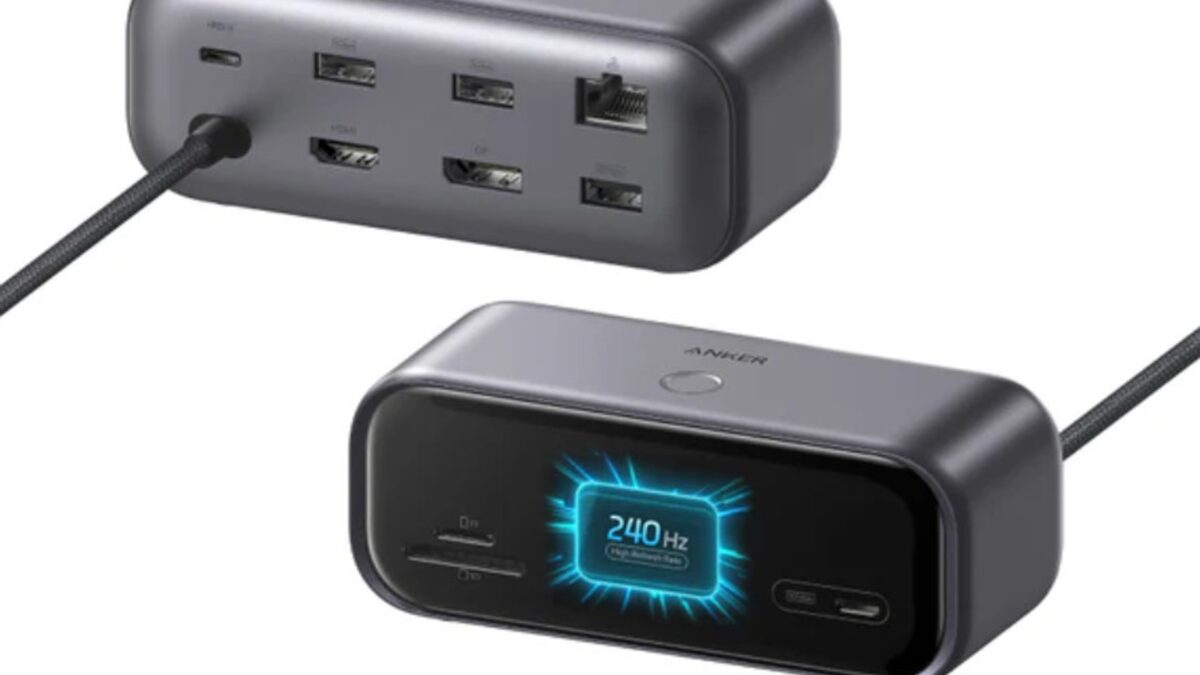
Anker has built a USB-C hub that looks like it escaped from a much fancier product category: the Nano USB-C Hub 10-in-1 Display Edition packs 10 ports, 4K at 144 Hz output, and a tiny built-in screen that refreshes at 240 Hz. The pitch is simple enough – plug it into a laptop and keep an eye on connected accessories and system status right on the hub itself – even if Anker has not bothered to explain why the display needs such a ludicrously high refresh rate.
Sales in Japan are set to begin in autumn 2026, with pricing around $110. That puts the Anker Nano USB-C Hub in premium-hub territory, where brands like CalDigit, Ugreen, and Belkin already fight for the same desk space with more conventional designs and fewer gimmicks.
Anker Nano 10-in-1 port layout
The hub connects to a laptop with a single USB-C cable and splits that into a fairly serious spread of ports. On the front, there is a USB-C port rated up to 10 Gbps, plus SD and microSD slots. Around back are a USB-C power input rated up to 100 W, three USB-A ports, HDMI 2.1, DisplayPort 1.4, and Gigabit Ethernet.
- 1 USB-C port up to 10 Gbps
- SD card slot
- microSD card slot
- 1 USB-C power input up to 100 W
- 3 USB-A ports
- HDMI 2.1
- DisplayPort 1.4
- Gigabit Ethernet
4K at 144 Hz and a 240 Hz status screen
Both HDMI and DisplayPort support 4K output at 144 Hz, which is the sort of spec sheet line that makes the hub feel more like a docking station than a simple adapter. The odd part is the tiny display on the front, which shows load and connection data and can surface more detailed statistics through Anker’s app. That extra telemetry may be handy for people who actually monitor peripherals; for everyone else, it is a neat way to spend engineering effort on something most hubs never try.
The hardware itself is not exactly pocketable, either. Anker says the hub measures 130 × 56 × 50 mm and weighs 300 g, so this is a desktop companion rather than a travel accessory. In other words: a serious hub with a playful face.
A premium hub aimed at power users
Products like this usually live or die on whether the convenience beats the clutter, and Anker appears to be betting that power users will pay extra for a cleaner setup and a live readout of what is happening on the bus. That makes more sense than a lot of gadget theatrics. The real test will be whether the display proves genuinely useful, or whether it ends up being the most expensive status light on a desk.