

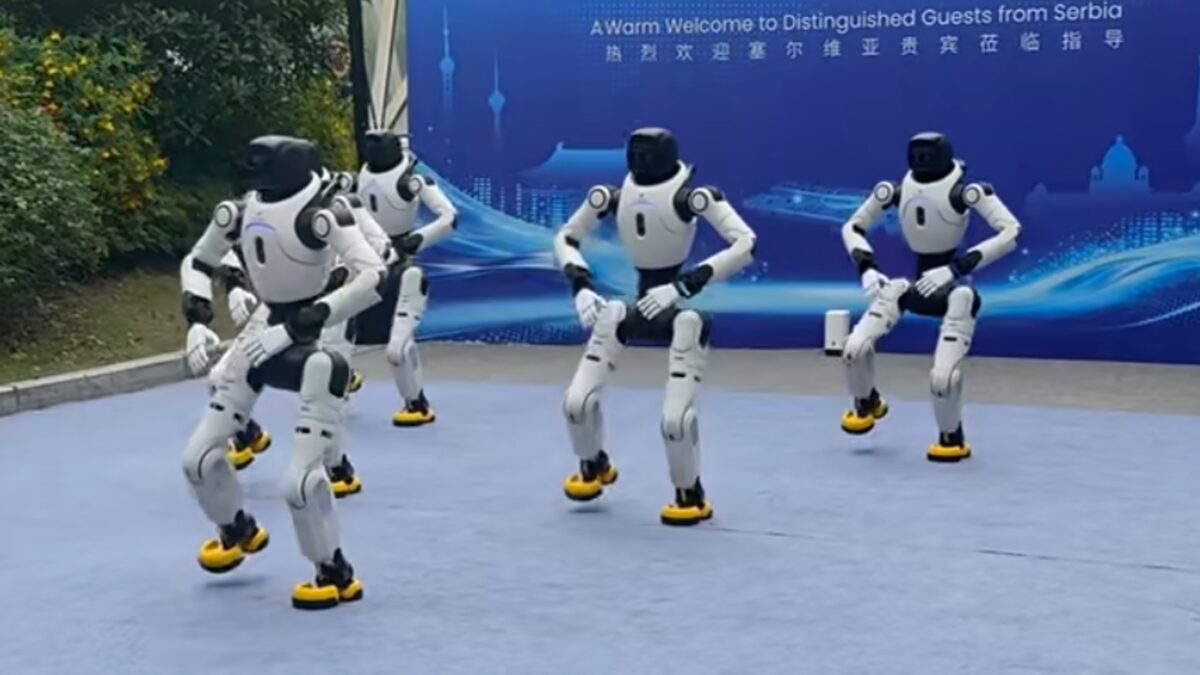
Serbian President Aleksandar Vučić got a front-row seat to China’s robotics ambition in Zhejiang, where Chinese humanoid robots greeted his delegation, shook hands, and even performed a traditional Serbian dance. The spectacle did what these demos are designed to do: sell a future in which robots are less lab curiosities and more public-facing products.
Vučić was impressed enough to post footage and declare that the robots ”dance better than me” and look like something out of the 22nd century. That’s not a policy paper, but it is a useful snapshot of where China’s robotics pitch has moved: from industrial arms hidden behind factory walls to polished displays aimed at governments, buyers, and anyone who still thinks humanoids are science fiction.
Chinese humanoid robots put on a stage show in Zhejiang
Vučić and his delegation visited Jiaxing, in Zhejiang province, for a tour of the future Minth Group plant. There, several humanoid robots showed off their abilities in front of the visiting Serbian team, with the dance routine becoming the day’s viral moment. The choreography was set to traditional Serbian music, which is a neat way of making advanced hardware feel oddly personal.
That kind of presentation is no accident. Chinese robotics firms have been leaning hard into public demos as competition intensifies with rivals in the US, Japan, and Europe, where humanoid projects are also racing from prototypes toward commercial use. The message is simple: China wants to be seen not just as the biggest manufacturing base, but as a place where robots can already perform useful, and memorable, tricks.
What the robots were showing off
The delegation also watched a broader set of robot systems, including a humanoid robot that can greet visitors in English and shake hands, a panda-shaped robot that can turn flexibly and do a backflip, a fighting robot, and a quadruped machine built to handle rough terrain. In other words: the full demo menu, from charm to brute force.
- Humanoid robot: greets visitors in English and shakes hands
- Panda-shaped robot: flexible turns and backflips
- Fighting robot: combat-oriented demonstration
- Quadruped robot: adapts to difficult terrain
Vučić later said Zhejiang’s robotics technology is creative and capable of changing life. That sounds like standard summit-language, but the underlying point is hard to miss: countries hosting these demos want to look like future partners, not just customers. The sharper competition now is not whether robots can impress a visiting delegation; it is which companies can turn that theater into repeatable sales, and which governments will be first in line.
The next test is less glamorous
The dance clip will travel farther than any technical spec sheet, but the real test for humanoid robots is still boring stuff: reliability, cost, and whether they can do more than entertain a VIP room. If Chinese firms can keep pairing polished demos with actual deployment, the rest of the market will have to answer with more than better marketing.