

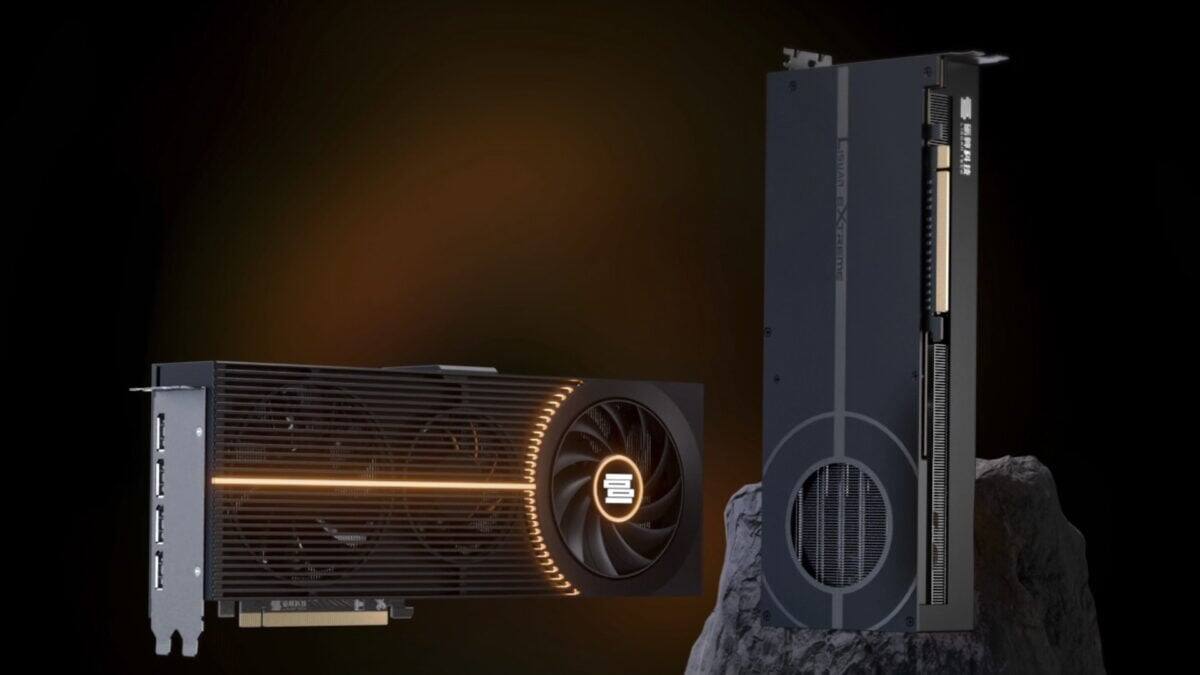
China’s first wholly homegrown GPU has arrived, and the headline is less ”Nvidia killer” than ”proof of life.” Lisuan Tech’s LX 7G100 is built without Nvidia or AMD microarchitecture, is said to have sold out its original 30,000-unit run, and manages enough compatibility to run Windows, DirectX 12, Vulkan, OpenCL, and OpenGL. Performance, though, is firmly in the budget end of the pool.
That matters because the real gap in PC hardware right now is not bragging rights, it’s supply and price. Nvidia and AMD still own the GPU conversation, but as graphics cards and memory keep creeping upward, even a mediocre domestic alternative can find a market if it gives buyers a way out of imported pricing pain.
Lisuan LX 7G100 specs and price
The LX 7G100 comes with 12GB of VRAM and a price equivalent to just under $500 in Chinese yuan. On paper, that puts it in the same broad territory as cards such as the Nvidia GeForce RTX 5060 Ti and AMD Radeon RX 9060 XT. In practice, its benchmark results land much closer to older, cheaper hardware – which is hardly the pitch anyone was hoping for, but it is still a first-generation chip from a company trying to build a complete GPU stack from scratch.
- Memory: 12GB VRAM
- Price: equivalent to just under $500 in Chinese yuan
- API support: DirectX 12, Vulkan, OpenCL, OpenGL
- Compatibility: Windows
Lisuan LX 7G100 benchmarks lag behind older Nvidia and Intel cards
Benchmark testing shared by YouTuber Chaowanke shows the LX 7G100 landing around, or just below, an Nvidia RTX 3060 in 3DMark Fire Strike. An RTX 4060 was reported to score 25% higher, while Intel’s Arc B580 came in 44% ahead in 3DMark Time Spy. In Cyberpunk 2077 at 1080p on Medium settings with FSR 3 upscaling and frame generation enabled, the Lisuan card reached about 88 average fps, versus 232 average fps for an RTX 4060.
That is not a flattering comparison, but it is also not the whole story. China’s consumer hardware push is happening against a backdrop of geopolitical friction and a global GPU market that has been bent around AI demand for years, leaving regular PC buyers to absorb the leftovers. A card that is merely decent, available, and not tied to western supply chains could still find a lane.
Why a weak GPU still gets attention
The more interesting part of Lisuan’s debut is that it exists at all. Competing with Nvidia’s best products was never a realistic first step, especially with the company’s own consumer lineup looking increasingly like a tax on anyone building a PC for fun rather than for work. If Chinese vendors can keep chipping away at the entry and midrange tiers, the market could look a lot less one-sided than it does now.
That pressure is not limited to graphics cards. Memory and SSD pricing has been increasingly shaped by a small group of dominant suppliers in South Korea and the U.S., many of them focused on HBM for AI data centers. Chinese memory maker CXMT’s work with Corsair on 16GB DDR5 sticks suggests the same pattern may be spreading beyond GPUs: first comes a basic product, then the market starts asking whether the price finally has somewhere to go but down.
What Lisuan needs to improve next
The LX 7G100 does not need to win a benchmark trophy to matter, but it does need to move fast from ”functional” to ”competitive.” The next test is whether Lisuan can improve performance without losing the compatibility that makes the card interesting in the first place. If it can, Nvidia and AMD will have something more annoying than a curiosity on their hands: a real domestic challenger, however awkward the opening act may be.