

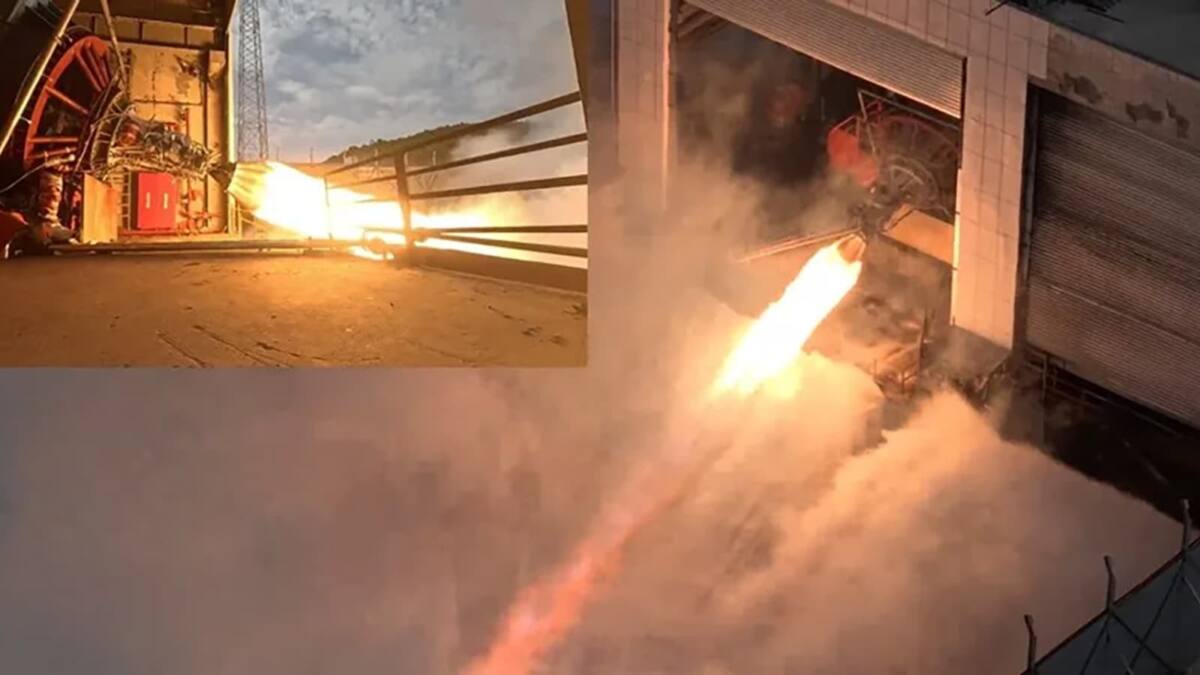
A Chinese startup says it has pulled off a milestone that many rocket makers spend years chasing: a reusable liquid-fuel engine with variable thrust, rapid-restart capability, and a design aimed at both upper stages and booster duty. Mega Engine Technology, based in Xi’an, says its ”Chi” engine has now completed long-duration hot-fire testing and emerged intact, which is exactly the kind of result that gets attention in a market where reliable engines are the bottleneck, not shiny launch graphics.
The timing is interesting, too. Space startups in China have been racing to build domestic launch hardware fast enough to support a growing commercial launch sector, and engine suppliers are suddenly just as important as rocket builders. If Mega Engine’s numbers hold up in broader testing, it could position itself as a contractor for other companies rather than trying to build an entire launch stack alone – often the smarter play.
Chi engine test results
The company said the engine ran for a combined 1,000 seconds in nominal operating mode during the latest test campaign, bringing total test time across the program to 2,000 seconds. It also claimed the engine delivered quick starts, stable performance across all phases, and passed final inspection after extreme thermal loads without damage to its hardware or internal components.
Chi is a closed-cycle liquid rocket engine burning kerosene and liquid oxygen, with afterburning of the oxidizer-rich gas generator exhaust. That architecture is the high-performance route for modern launch vehicles, but it is also less forgiving to develop than simpler open-cycle designs. In other words: elegant on paper, expensive in headaches.
Reusable rocket engine thrust range and performance
Mega Engine says the reusable rocket engine belongs to the 80-ton thrust class and can throttle from 35 tons to 75 tons at sea level, while reaching a maximum of 87 tons in vacuum. Specific impulse is listed at 302 seconds at sea level and 350 seconds in higher altitude conditions.
- Thrust class: 80 tons
- Sea-level thrust range: 35 to 75 tons
- Vacuum thrust: 87 tons
- Specific impulse: 302 seconds at sea level
- Specific impulse: 350 seconds at altitude
Where Mega Engine fits in China’s launch race
The real prize here is not just performance, but flexibility. Mega Engine says the engine supports thrust vector control, variable thrust, and multiple restarts in flight, making it suitable for second and upper stages on medium and heavy launchers, or as a first-stage main engine for lighter and medium rockets. That broad use case is attractive for commercial launch companies that do not want to redesign around a one-off engine family every time they change vehicle size.
The company only began operating in early 2024, yet it says it has already demonstrated a fully working high-efficiency kerosene-oxygen closed-cycle engine. That is a fast track by any measure, though the next test targets matter more than the announcement itself. The difficult part for engine startups is usually not proving one engine can run once; it is proving the same engine can be manufactured, restarted, and trusted at scale without turning launch schedules into a joke.
If Mega Engine keeps advancing, its most likely customers are other commercial launch firms building new Chinese rockets, not just its own in-house program. That could make Chi less of a headline-grabber than a supply-chain linchpin, which is probably the better business anyway.