

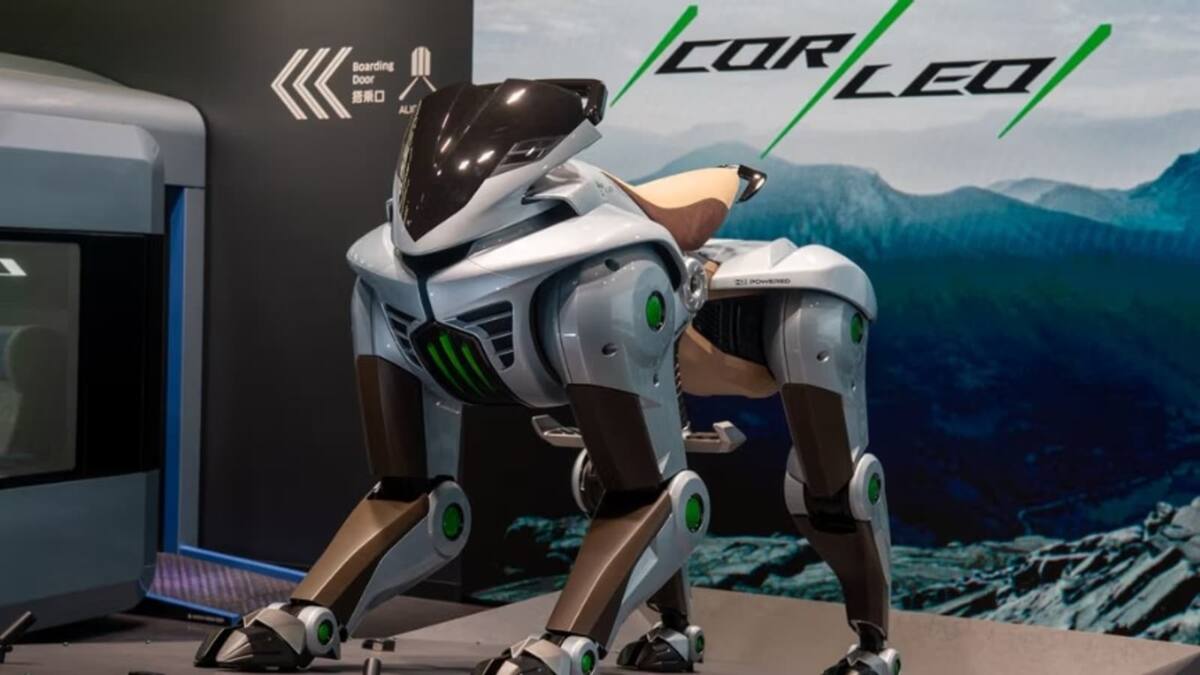
Kawasaki Heavy Industries is teaming up with Nvidia and Fujitsu to build a shared development center in San Jose, California, aimed at ”physical AI” for robots. The focus is on medical robotics, elder care, and personal mobility, with the flashiest test case being Corleo, Kawasaki’s unusual four-legged machine for rough terrain. Investors liked the story immediately – Kawasaki shares jumped almost 12% on Friday, their biggest one-day rise since February.
The move fits a broader race that is quietly redrawing robotics. Japanese manufacturers have spent decades perfecting industrial machines that do one job very well; now they are being pushed toward systems that can sense, decide, and adapt outside the factory cage. That shift is already attracting the biggest American AI platforms, which see robots as the next battleground after chatbots and cloud software.
Corleo is the proof-of-concept
Corleo is not your average concept vehicle. Kawasaki describes it as roughly the size of a large motorcycle, powered by a 150-cubic-centimeter hydrogen engine that drives the robot’s leg actuators, while the rider steers by shifting body weight rather than turning a handlebar. The company still plans to show the platform at Expo 2030 in Riyadh and aims to bring it to market by 2035.
For Nvidia, the appeal is obvious: its simulation tools and AI models can train robot control systems in virtual environments before anyone risks hardware in the real world. That’s the unglamorous part of robotics that actually ships products. A cool demo gets attention; a robot that survives the mess of streets, hospitals, and homes needs a lot more than charisma and a cinematic silhouette.
Japan’s robot makers are chasing AI partners
Kawasaki is not alone. Earlier this month, Fanuc struck a similar deal with Google, folding Gemini Enterprise and Intrinsic technology into more than 1.1 million industrial robots worldwide. That is a clear signal that the next phase of robotics is not just better motors or stronger grippers; it is software from the same companies that built the modern AI stack.
The timing matters for Japan. An aging population has made medical and care robots a national priority, and companies that can build machines for hospitals, assisted living, and transport stand to benefit first. The harder question is whether the market rewards polished prototypes or actual deployment, because so far Corleo has attracted enormous attention – about 1.2 billion views and mentions on social media after its Osaka Expo 2025 appearance – without yet proving it can become a mass-produced product.
What Kawasaki and Nvidia could unlock next
If the San Jose center works, Kawasaki gets more than a headline-grabbing partner. It gets a path to turn a viral concept into a testable platform for robots that can move through unpredictable environments, which is where the real money is hiding. The bigger open question is whether this alliance produces a single memorable robot, or a repeatable model for how AI giants and Japanese hardware firms build the next generation of autonomous machines together.