

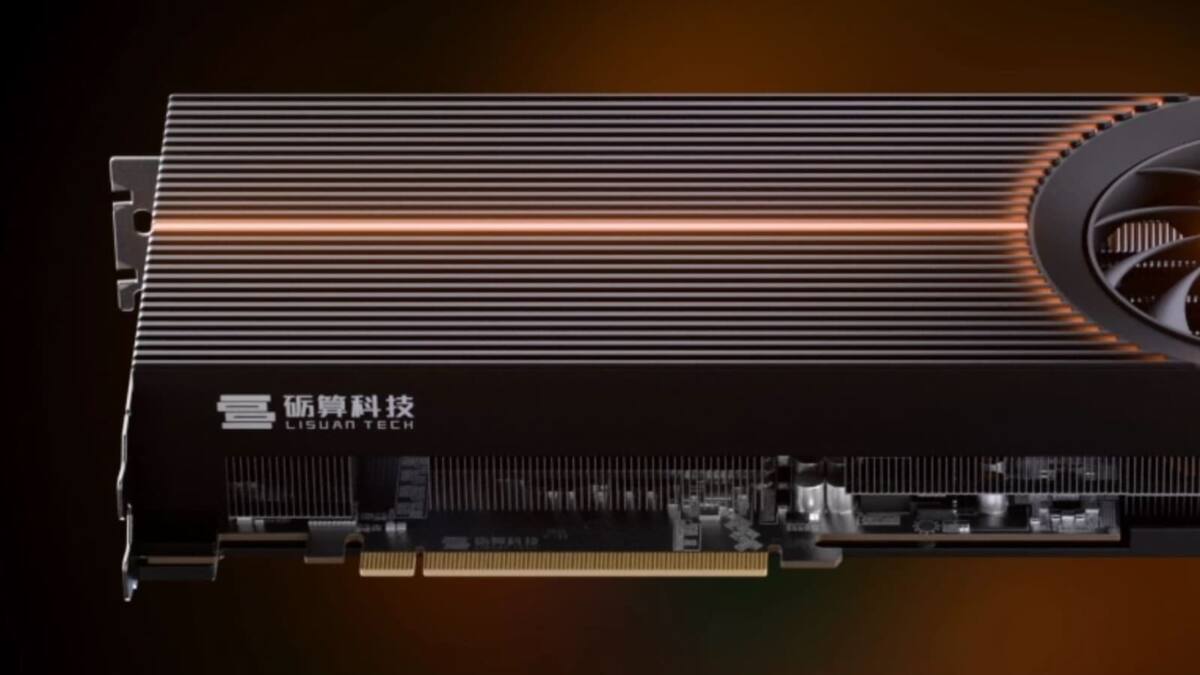
Lisuan Technology says its first gaming graphics card, the Lisuan LX 7G100, drew more than 30,000 orders in 48 hours in China, even though early testing suggests it performs below a GeForce RTX 3060 despite a $500 price tag. That is a very specific kind of success: not the fastest card, not the cheapest card, but the one with enough local appeal, software support, and national pride to move inventory fast.
The company also pushed out a Microsoft WHQL-certified driver and a tuning guide for 40 popular modern games, which matters more than it sounds. Chinese GPU makers have spent years trying to escape the ”it boots, technically” phase, and a clean WHQL stamp plus out-of-the-box DirectX 12 support is the sort of boring paperwork that can actually sell hardware.
Lisuan LX 7G100 specs and features
Lisuan LX 7G100 is built on a 6-nanometer GPU and ships with 12GB of GDDR6 memory. It supports DirectX 12, Vulkan 1.3, OpenGL 4.6, and OpenCL 3.0, uses 225W of power, and includes four DisplayPort 1.4a outputs. On paper, that is enough to make it look like a serious modern card, even if the benchmark numbers are less flattering.
- GPU process: 6 nanometers
- Memory: 12GB GDDR6
- Power draw: 225W
- Video outputs: four DisplayPort 1.4a ports
- API support: DirectX 12, Vulkan 1.3, OpenGL 4.6, OpenCL 3.0
Why buyers moved so fast
The obvious comparison is with Nvidia, AMD, and Intel, the established trio that dominates discrete graphics. Lisuan is trying to prove a domestic alternative can launch with proper driver certification, game support, and enough availability to matter, and the first batch suggests buyers are willing to reward that effort before the performance crown arrives.
It also helps that China’s homegrown chip efforts increasingly benefit from a practical rather than purely technical sales pitch. If a card is usable in mainstream games, officially supported by Microsoft, and locally available in volume, some shoppers will forgive a lot, including the awkward fact that a $500 ”RTX 4060 rival” apparently lands closer to an RTX 3060.
The benchmark gap with GeForce RTX 3060 and RTX 4060
That performance gap is the catch. Lisuan originally positioned the LX 7G100 as a GeForce RTX 4060 equivalent, but early tests reportedly put it below the GeForce RTX 3060 instead. In most markets that would be a problem; in this one, the stronger story may be that a Chinese gaming GPU exists at all and can ship with official driver support instead of a pile of hopes and forum posts.
The next test is less dramatic but more important: whether Lisuan can keep producing cards, improve driver maturity, and make the hardware better without losing the momentum that turned the first 30,000-unit wave into a sellout. The benchmark tables may have the last word, but for now the market has already given its own answer.