

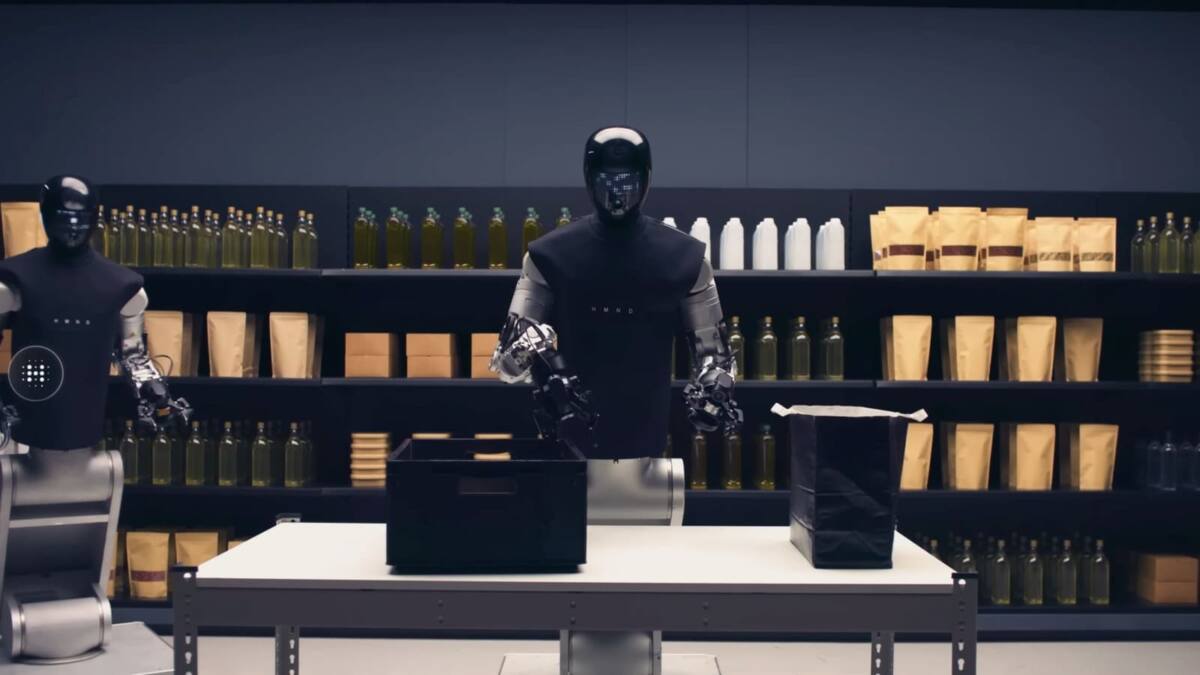
Bosch is moving from supplier to builder in the humanoid robots race. The German industrial giant has struck a strategic deal with London-based Humanoid to manufacture the HMND platform for the European market after pilot trials at a Bosch logistics site in Buehl showed the robots could sort and move boxes of different sizes, weights, and shapes without human help.
The timing is sensible for both sides. Humanoid gets access to Bosch’s production muscle and supply-chain discipline; Bosch gets a front-row seat in a category that is shifting from demo theater to actual warehouse work. That is the part investors and factory operators care about, not the marketing gloss about ”humanoid” robots. The real test is whether they can keep working repeatably, cheaply, and safely once they leave the lab.
Bosch will handle production and engineering
Under the agreement, Bosch will not just assemble the machines in its own facilities. It will also apply engineering methods to simplify the design, reduce manufacturing costs, and help build out the supply chain. Humanoid also plans to integrate Bosch drive systems, sensors, and actuators into the HMND platform over time, which is the kind of vertical integration that can make a robot platform more competitive – and much harder for rivals to copy quickly.
That matters because humanoid robotics has a habit of running ahead of industrial reality. A lot of companies can show a robot walking or waving; far fewer can produce one that is economical enough for logistics, manufacturing, and other repetitive jobs. Bosch’s role suggests Humanoid is betting that scale, not spectacle, is what will separate the winners.
HMND comes in two versions
The HMND platform is offered in two variants, each aimed at different deployment needs:
- Two-legged version: 178 cm tall, 90 kg, up to 1.5 m/s, up to 3 hours of autonomous operation.
- Wheeled version: 221 cm tall, 300 kg, up to 2 m/s, up to 4 hours of operation.
- Both versions: dual-arm systems and payload capacity of up to 15 kg.
That split is telling. The wheeled model is the pragmatist’s choice: more stable, faster, and better suited to controlled industrial floors. The bipedal version is the showpiece, but also the harder engineering problem. If the market is smart, it will buy the easier machine first.
KinetIQ runs the robot fleet
Humanoid says its KinetIQ AI coordinates mixed fleets of wheeled and two-legged robots as one system. The top layer acts like a dispatcher and connects to enterprise IT, the middle layer handles planning using multimodal vision, and the lower layers control motion, balance, and grasping at 50 Hz and sub-second speed. In other words: the company is trying to sell not just robots, but orchestration.
That approach is becoming the industry’s favorite shortcut to usefulness. Amazon, Figure, and a growing list of warehouse automation players are all chasing the same promise: fewer isolated robots, more coordinated labor. Bosch’s partnership gives Humanoid a credible route to scale in Europe, and a parallel contract with Schaeffler is expected to drive broader deployment at factories there from the end of 2026.
Europe gets the first real test
The pilot at Bosch’s Buehl logistics site was the important proof point, but the real verdict will come once the robots move from controlled trials into repetitive industrial use. If Bosch can help turn HMND into a manufacturable product at the right cost, Humanoid may have the kind of partner that turns a promising platform into a shipping business. If not, it will join the long line of robotics companies that looked inevitable right up until production economics arrived.