

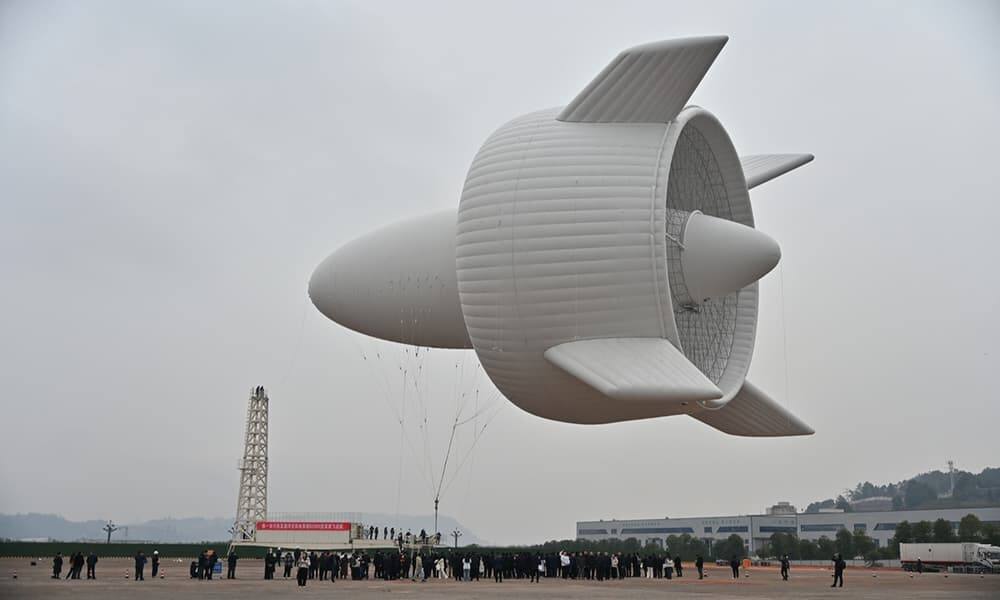
China has taken a very literal leap into airborne wind power. Engineers behind the SAWES Type S2000 say their helium balloon platform can generate electricity at altitudes of up to 2,000 meters, where winds are stronger and steadier than near the ground, and they claim the system now reaches megawatt-class output.
The project, developed by Tsinghua University and startup SAWES Energy Technology, swaps the familiar tower-and-blade setup for a 60-meter helium-filled airship carrying 12 turbines with a combined 3 megawatts of output. Electricity is sent down to the ground through a cable, which is a neat trick right up until you remember cables, weather, and aviation all exist.
How SAWES Type S2000 works
SAWES says one hour of operation could be enough to fully charge about 30 electric cars, which gives the concept a handy real-world benchmark. That does not make it a replacement for conventional wind farms yet, but it does show the system is more than a science fair balloon with ambitions.
The appeal is obvious. Higher up, wind is usually stronger and more stable, while the platform avoids the heavy concrete foundations and large land footprint of standard turbines. China has plenty of sparsely populated territory where that trade-off may look especially attractive, which helps explain why it is investing in this direction instead of treating it as a novelty.
The hard limits are still very real
There is a reason most wind farms are still on the ground. Storms force the airships back down, the tether is under constant stress, and wear on the cable is a practical headache rather than a footnote. Add the risk to helicopters and rescue aircraft that may operate at similar heights, and the airspace management questions get serious fast.
That said, China’s broader green-energy push gives the project a bigger role than a single prototype. It sits alongside solar expansion, battery manufacturing, and hydrogen infrastructure, all part of a strategy to build more of the clean-energy stack at home. If the economics hold, airborne wind could become a useful way to tap high-altitude resources that traditional turbines simply cannot reach.
What happens if the economics work
The next test is not whether SAWES can fly. It is whether it can do so reliably, cheaply, and safely enough to matter beyond a headline. If it passes, expect other countries and turbine makers to take a harder look at tethered wind systems. If it fails, it will still have done one useful thing: remind the industry that the atmosphere above our heads is a much better energy source than most rooftops.