

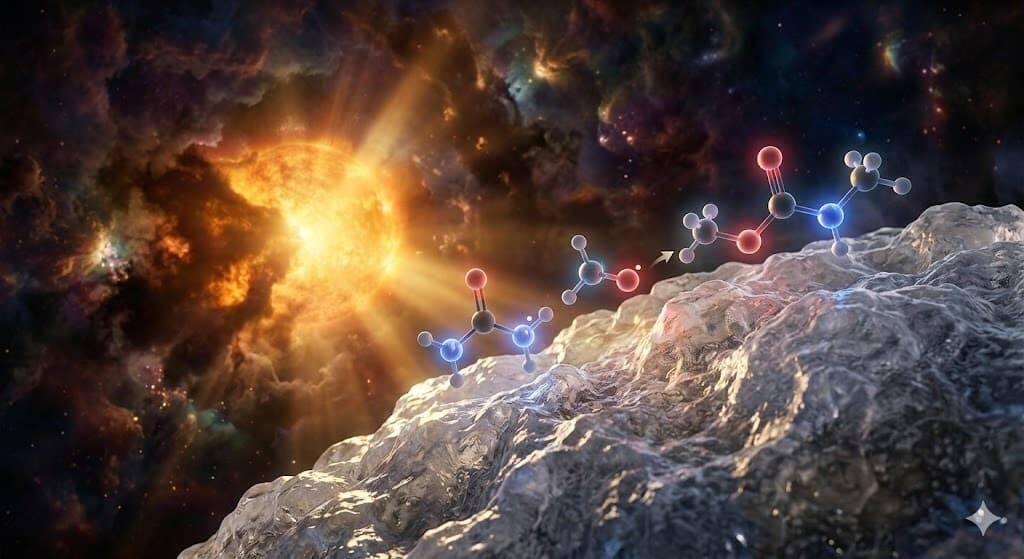
An international team of astrochemists has detected methyl carbamate in the hot core of the young stellar system G358.93-0.03 MM1, giving researchers a fresh tracer in the long hunt for glycine, the simplest amino acid and one of astrobiology’s most elusive prizes. The find matters because it shows that complex prebiotic chemistry is already active in the earliest, messiest stages of star and planet formation, not just in calm laboratory beakers.
Methyl carbamate is a structural cousin of glycine: the same atoms, arranged differently. That sounds like chemistry nerd poetry, but it gives astronomers something practical – a marker molecule that can help narrow where glycine-like compounds form, survive, and get destroyed across interstellar clouds.
How ALMA picked out 10 radio markers
The ALMA detection came from Chile, whose millimeter-wave sensitivity makes it the obvious instrument of choice for a region as crowded as this one. In a hot molecular core packed with overlapping spectral lines, the team says it isolated 10 independent radio signatures pointing to methyl carbamate, suggesting the molecule is not just present but relatively abundant.
That is a small but meaningful jab at a long-standing assumption in chemistry: that space should naturally favor the most stable molecule available. Astronomers have been seeing for years that interstellar chemistry is more opportunistic than tidy, and this result fits that pattern rather than the textbook idealization.
Dust grains, ice mantles and a sudden warm-up
The modeling points to a surface reaction on microscopic dust grains rather than a gas-phase process. Frozen mantles of simple compounds form the raw material, and when a newborn massive star heats the surrounding cocoon, radicals move, meet, and snap together without an activation barrier.
That mechanism also explains why the molecule shows up in a hot core at all: the chemistry happens cold, then the heat acts like an eject button, pushing the finished product into the gas where telescopes can see it. The same kind of grain-surface pathway has become a familiar theme in astrochemistry, but the new detection strengthens the case that it can build bigger, biologically interesting molecules efficiently.
A new marker for prebiotic chemistry
Researchers also compared the ratios of methyl carbamate with its precursors, methanol and formamide, and found them consistent with other protostellar systems. That is useful because astrochemistry rarely gets neat proof; it gets patterns, repeats, and enough consistency to make the story believable.
For astrobiology, the bigger win is methodological. Glycine itself has stayed maddeningly difficult to pin down in deep space, but chemically related compounds may now give observers a better roadmap. If more clouds show the same family resemblance, the field could finally move from guessing where life’s ingredients come from to actually tracking how they assemble.
What astronomers will test next
The obvious next step is a wider survey of other molecular clouds and hot cores. If methyl carbamate keeps turning up where glycine should also be able to form, the ”simple stability always wins” rule will look even shakier, and the chemistry of star birth will look a lot more selective – and a lot less polite – than the old models suggested.