

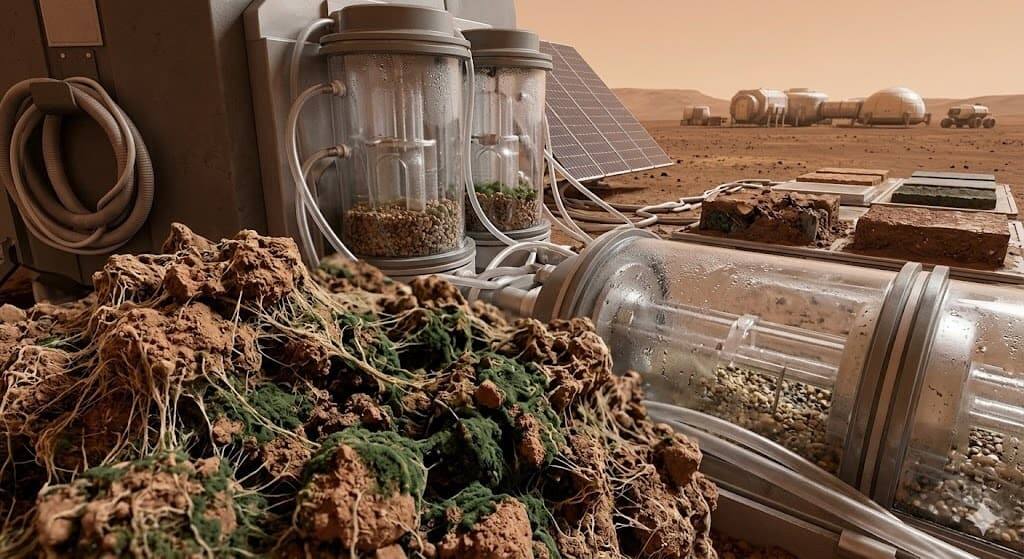
Lichen-like microbial communities have done something unglamorous but very useful: they grew on a Mars soil simulator and turned loose regolith into a harder material without external organic carbon or added nitrogen. That puts them in the narrow club of systems that might one day make construction on Mars less dependent on constant supply drops from Earth.
The work focuses on paired fungi and cyanobacteria, with the cyanobacteria doing nitrogen fixation and the whole consortium behaving like a tiny cooperative factory. The big deal is not that the microbes survived, but that they coordinated metabolism well enough to bind particles together and build a more connected structure from a granular substrate.
How the microbial consortium hardened regolith
Researchers tested assembled communities built from filamentous fungi and nitrogen-fixing cyanobacteria on a Mars regolith simulant. The setup deliberately avoided external organic carbon and extra nitrogen, which makes the result a better proxy for autonomous use on Mars than a garden-variety petri dish stunt.
Metabolite analysis showed coordinated shifts in metabolism tied to joint carbon and nitrogen handling inside the communities. In plain English: the microbes were not just sharing space, they were acting like a linked system, and that cooperation ended with mineralization and compaction of the soil particles.
- Substrate: simulated Martian regolith
- Inputs: no external organic carbon and no additional nitrogen sources
- Outcome: mineralized, denser material formed by microbial activity
Why this is more than a lab curiosity
NASA, ESA, and a growing list of private Mars planners have all run into the same dull problem: building on Mars is mostly a logistics problem dressed up as a science one. You can ship less if you can make more from local material, which is why biofabrication has attracted attention alongside 3D printing, sintering, and other ways to avoid hauling half a construction yard across space.
The catch is obvious. Integrating microbial material production with additive manufacturing is still only a concept, and the paper does not pretend otherwise. But if living systems can both nourish themselves and stiffen local soil-like material, that is a useful step toward self-sustaining manufacturing in places where resupply is slow, expensive, or impossible.
Microbial construction could help Earth too
Martian construction is the headline, but the more immediate use case could be extreme environments on Earth, where water, nutrients, and infrastructure are limited. If this kind of biology can be controlled reliably, it could become a template for producing materials in deserts, remote outposts, or disaster zones without a full industrial chain behind it.
The open question is whether these microbial systems can be made robust enough for real-world engineering rather than just elegant demonstrations. If they can, the next competition on Mars may not be between rockets alone, but between different ways of growing the stuff that builds a habitat.