

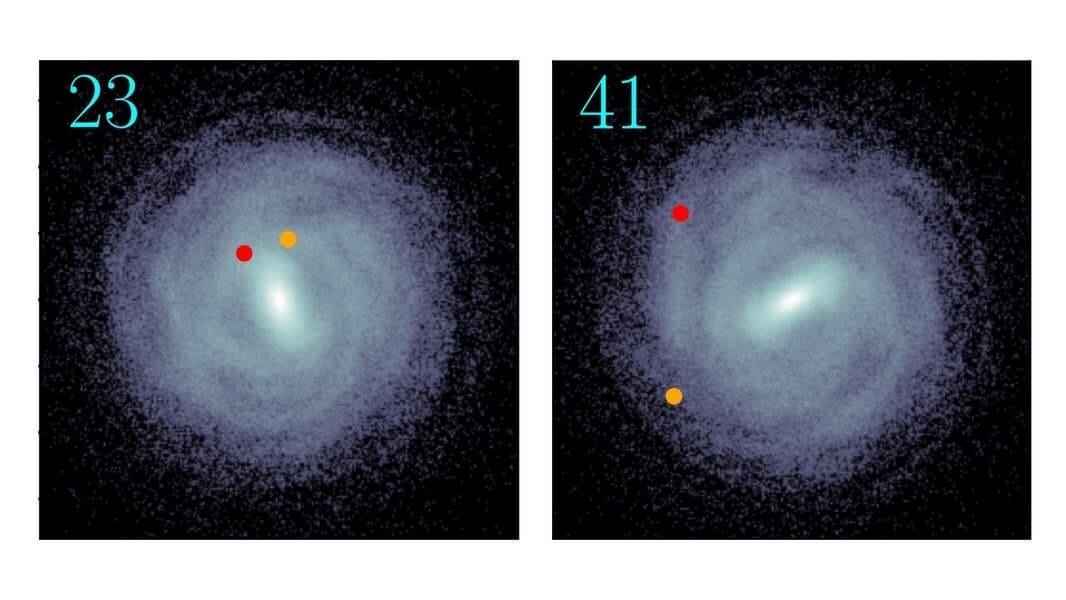
The Milky Way may be less orderly than astronomers liked to imagine. New simulations from Leiden Observatory suggest that even a tiny nudge – the equivalent of shifting a single star – can ripple through the Milky Way and eventually change the shape of its spiral arms and central bar.
That does not mean the galaxy flies apart in a drama queen fit. It means the familiar, neat picture of a ”smooth” disk is too tidy for the physics involved. In a system with hundreds of billions of stars, small differences can survive long enough to matter, especially if the model is sensitive to close gravitational encounters.
How tiny changes spread through a galaxy
The research team built hundreds of Milky Way-like models: flat stellar disks embedded in massive dark matter halos. Each round of simulations was almost identical, except for a microscopic change such as a slight shift in one star. Over time, the runs drifted apart. Spiral arms formed differently, and the central stellar bar changed both its shape and rotation speed.
The result echoes the butterfly effect: a small perturbation at the start can lead to a very different outcome later on. That is a problem for anyone who assumed galaxies should average out into predictable, statistically neat systems.
Why earlier Milky Way models disagreed
The study also helps explain why older astrophysical simulations reached opposite conclusions about chaos. Some found that adding more stars increased chaotic behavior, while others found the reverse. The missing ingredient was the way gravity was handled at very small distances.
In many calculations, gravity is ”softened” so the math stays stable and the computer does not melt into a sad pile of fan noise. Instead of treating stars as perfect points, models spread them into small clouds, which reduces close-range interactions. That makes simulations cheaper to run, but it can also wash out the very encounters that drive real galactic chaos.
Source: UL / Portegies Zwart / Asano
A chaotic galaxy can still look familiar
There is a limit to the disorder. Different simulations can produce different spiral patterns or bar orientations, but the galaxy still ends up looking like a galaxy. The researchers argue that this is the real compromise: the Milky Way can be both broadly predictable and locally chaotic, depending on the scale you care about.
The timescale is the sharpest reminder of how slippery this system is. The study says the Milky Way’s structure loses predictability after about a million years – a blink against the galaxy’s roughly 10 billion-year age. Expect more modelers to revisit how they treat gravity in crowded stellar neighborhoods; otherwise, they may be simulating a cleaner universe than the one actually out there.