

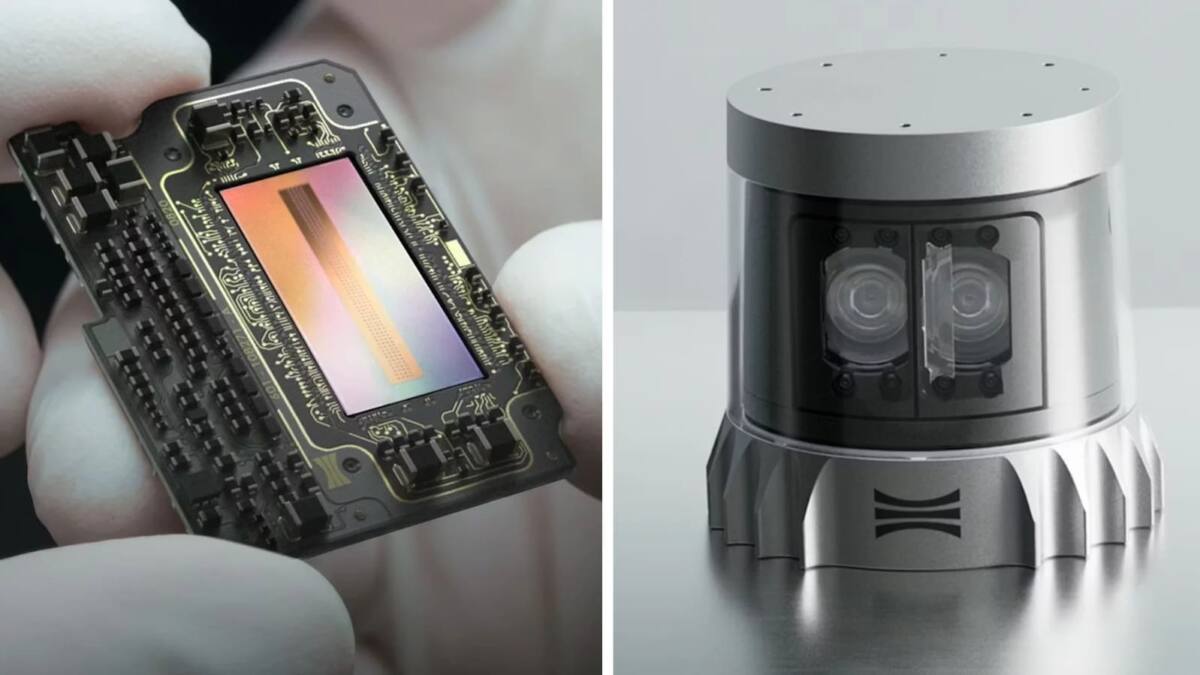
Ouster says its new Rev8 OS lidar family is the first to build a color 3D view of the world directly inside the sensor, without relying on a separate camera. That is a neat bit of engineering and a very practical one: robots and vehicles get richer scene data with fewer synchronization headaches, which is the sort of boring win that usually turns into a real commercial advantage.
The company’s pitch is simple enough. Each point in the cloud now carries both position and color, so the sensor is doing in one box what often takes a lidar, a camera, and software glue to combine. In a field where rivals are still chasing range, resolution, and cost, Ouster is trying to make ”what is it?” easier for machines to answer.
Rev8 OS specs and models
The new Rev8 OS lidar lineup is built on Ouster Silicon L4 and includes two chips: the 128-channel L4 and the more powerful 256-channel L4 Max. Ouster says they are roughly twice as far-reaching and more accurate than the previous generation, while handling up to 10.4 million points per second. The family includes updated OS0, OS1, and OSDome, plus the flagship OS1 Max, which can see objects up to 500 meters away.
- 128-channel L4 and 256-channel L4 Max
- Up to 10.4 million points per second
- OS1 Max range: up to 500 meters
- Designed for industrial and automotive use
Why color matters for robots and cars
Color sounds like a nice-to-have until you think about what machines actually struggle with: traffic lights, road signs, lane markings, and objects that look similar in plain depth data. Ouster says the sensor is built to preserve color detail across dim light and bright daylight, which is exactly the kind of range problem lidar has long left to cameras. If that holds up in deployment, it could simplify autonomous stacks that currently spend too much time reconciling two imperfect views of the same scene.
There is also a broader pattern here. Automotive sensing has been drifting toward more integrated, multi-purpose hardware, because fleet operators and robotics builders do not want extra parts, extra calibration, or extra failure points. A lidar that carries both geometry and color inside the same device is Ouster’s answer to that obsession with simplification.
Safety, durability, and the road to deployment
Ouster says the new sensors are intended for long service lives of up to 10 years and meet automotive and industrial safety standards. That matters more than the marketing gloss: robots in warehouses, factories, and on public roads need hardware that survives heat, vibration, weather, and the occasional bad idea from a systems integrator.
The real question is whether color-native lidar becomes a must-have feature or just a premium checkbox. If competitors respond with their own integrated color sensing, this could push the whole market toward simpler perception stacks; if not, Ouster may have found a useful edge in a category where ”better data” is usually the hardest thing to sell and the easiest thing to need later.