

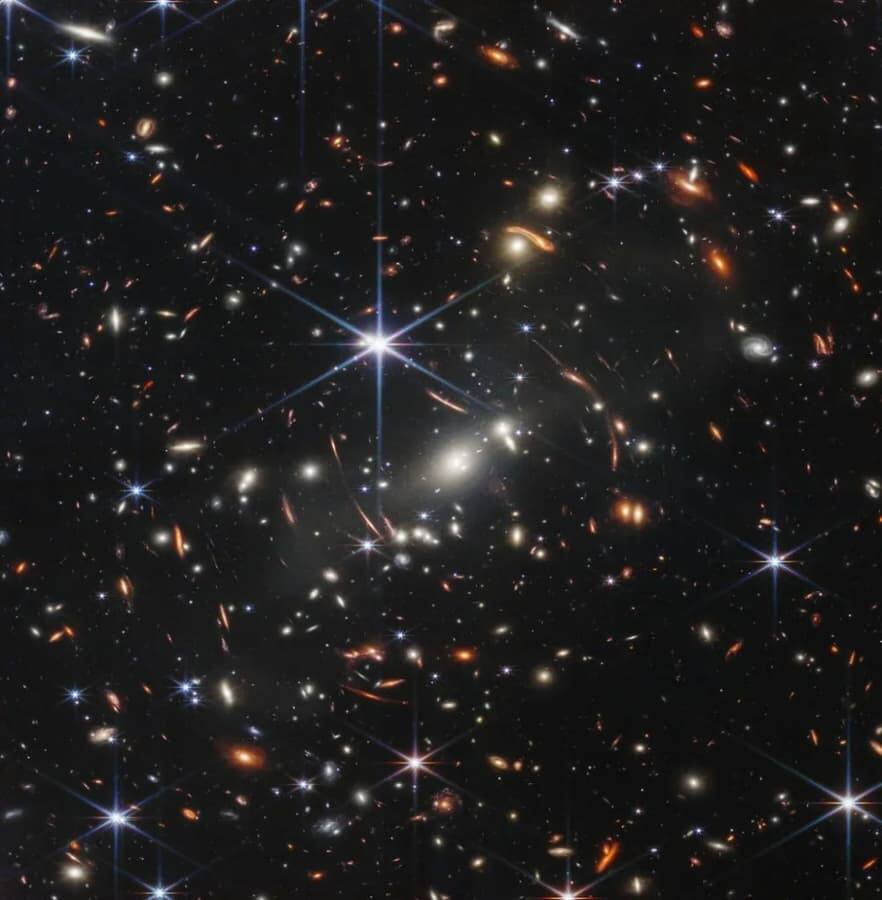
The James Webb Space Telescope has found LAP1-B, one of the most chemically primitive galaxies ever observed: a dim speck seen as it existed just 800 million years after the Big Bang. The catch is that Webb did not see it alone. A massive galaxy cluster acted as a natural magnifying glass, boosting the light enough for astronomers to study a system that would otherwise have stayed invisible.
That setup is doing a lot of the heavy lifting here. LAP1-B sits about 13 billion light-years away, is far too faint for direct detection, and still barely showed up even after being amplified by roughly 100 times by the gravity of the MACS J046 cluster. The real surprise is not just that astronomers found it, but that the galaxy seems to sit in a class of objects that may preserve the chemistry of the first star-forming systems.
A galaxy with almost no heavy elements
Using JWST’s spectrograph, the team examined the gas inside LAP1-B rather than starlight, because the galaxy is too faint to give up much of that. The measurements point to an extremely low oxygen abundance: just 0.4% of the solar level, one of the lowest values known for any galaxy. At the same time, the spectrum showed unusually strong carbon signatures and evidence of very hard ultraviolet radiation.
That combination is awkward for ordinary modern stellar populations, which is exactly why the researchers are interested. The data are consistent with the idea that LAP1-B may be lit by stars from population III, the first generation of stars made almost entirely from hydrogen and helium. Those stars are thought to have been huge, hot, and short-lived, then ended in violent supernovae that seeded later cosmic chemistry.
Dark matter appears to dominate the system
LAP1-B also looks wildly lopsided in the mass department. The gas inside the galaxy is moving at about 58 kilometers per second, far more than you’d expect for such a small system. The calculations put the galaxy’s total mass at around 10 million solar masses, while its visible matter accounts for only a fraction of that.
That leaves dark matter as the obvious suspect. In practical terms, the invisible halo may have been the thing that kept the primordial gas from drifting away long enough for the first stars to form. It is a neat reminder that in the early universe, the stuff we cannot see may have been doing most of the architectural work.
A clue to the faintest galaxies in the early universe
The researchers see LAP1-B as a kind of missing link in cosmic evolution, closer to the ultra-faint dwarf galaxies orbiting the Milky Way than to today’s bright spirals. Those nearby relics are believed to have largely stopped forming stars during the epoch of reionization, when ultraviolet radiation from the first galaxies heated intergalactic gas and made life harder for tiny systems.
The next step is obvious: find more objects like this one. If astronomers can build a larger sample of galaxies with similarly low heavy-element content, they’ll get a much clearer picture of how the first stellar systems formed, evolved, and then disappeared into the background of a much busier universe.