

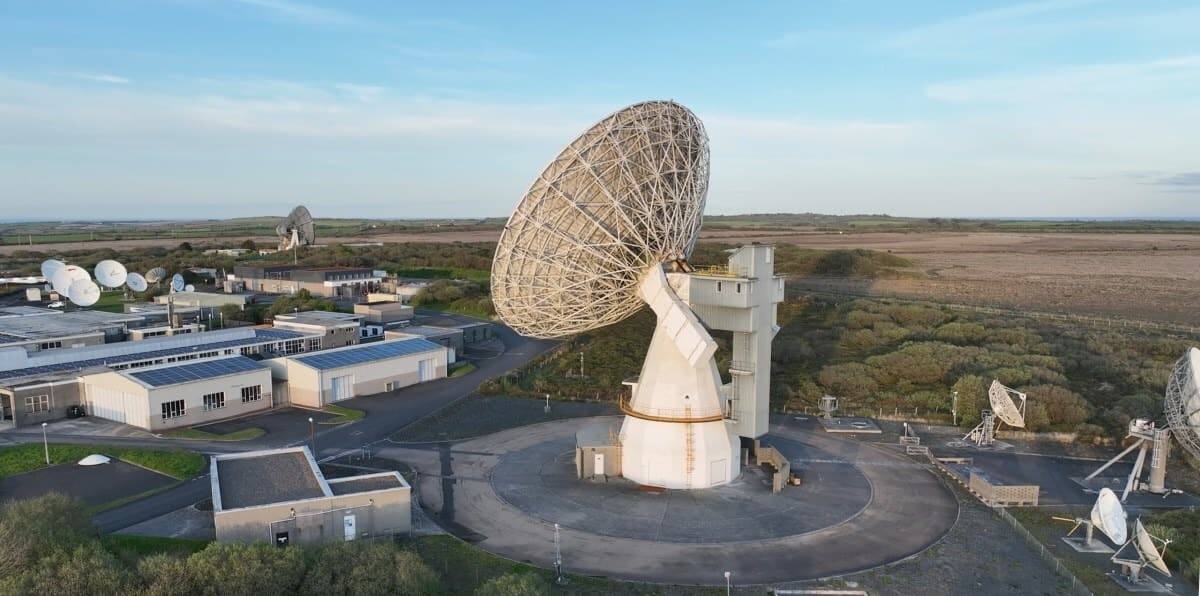
Intuitive Machines is buying Goonhilly Earth Station, the storied British deep-space communications site, for 37 million pounds, or about $49.6 million. The deal could turn the lunar lander company into a much broader space infrastructure player, and it also covers Goonhilly’s U.S. subsidiary, Comsat. The acquisition is set to close in the third quarter, once regulators in the U.S. and U.K. sign off.
The Intuitive Machines Goonhilly deal gives the Texas company a ready-made ground network with giant 30- and 32-meter antennas in Cornwall, plus teleports in Connecticut and California. That is the sort of hardware that can reduce the awkward handoffs that still plague deep-space operations. In other words, Intuitive Machines is trying to own more of the stack instead of renting critical pieces from everyone else.
Goonhilly is no stranger to lunar work. It has already handled data for Intuitive Machines’ IM-1 and IM-2 missions, so this deal formalizes a relationship that was already doing real work rather than just trading press-release adjectives. For Intuitive Machines, that history matters: reliability is the only romance the Moon allows.
Intuitive Machines Goonhilly deal adds a lunar ground network
Chief executive Steve Altemus says the goal is a seamless system that combines ground telescopes, navigation, positioning, and the company’s own relay satellites. The first piece of that satellite network is expected to begin deployment during the next lunar mission. If it works, customers could move from low Earth orbit to cislunar space without stitching together a patchwork of providers.
There is also a commercial angle baked into the acquisition. A physical base in the U.K. opens a more direct path to European Space Agency contracts, which is useful at a moment when demand for lunar services is rising and operators are scrambling to look less like one-off mission vendors and more like infrastructure companies.
NASA’s Artemis reset helps the timing
The purchase lands alongside NASA’s revised Artemis push, announced at the Ignition event on 24 March, which aims to increase the cadence of commercial lunar missions under CLPS. That is good news for anyone selling launches, landers, payload delivery, or communications support – and a reminder that the Moon business is starting to look less like exploration and more like a supply chain.
- Deal value: 37 million pounds, about $49.6 million
- Payment split: half cash, half stock
- Assets: Goonhilly Earth Station, Comsat, Cornwall antennas, Connecticut and California teleports
- Expected closing: third quarter, pending U.S. and U.K. approvals
Intuitive Machines is also pushing hard on hardware. After buying Lanteris Space Systems, formerly Maxar Space Systems, it says it can build multiple lander platforms in parallel on 24-month cycles. The company is awaiting NASA’s decision on the LTV rover program at the end of next week, and it has already updated its autonomous and crewed mobility designs after NASA asked bidders to simplify them for speed and durability.
The bigger question is whether this becomes the template for the next phase of lunar business: not just landing on the Moon, but owning the communications pipes, the relay layer, and enough of the industrial base to keep missions moving. If NASA’s push for more frequent commercial flights holds, rivals will have to decide whether to buy capacity, build it, or watch Intuitive Machines try to do both.