

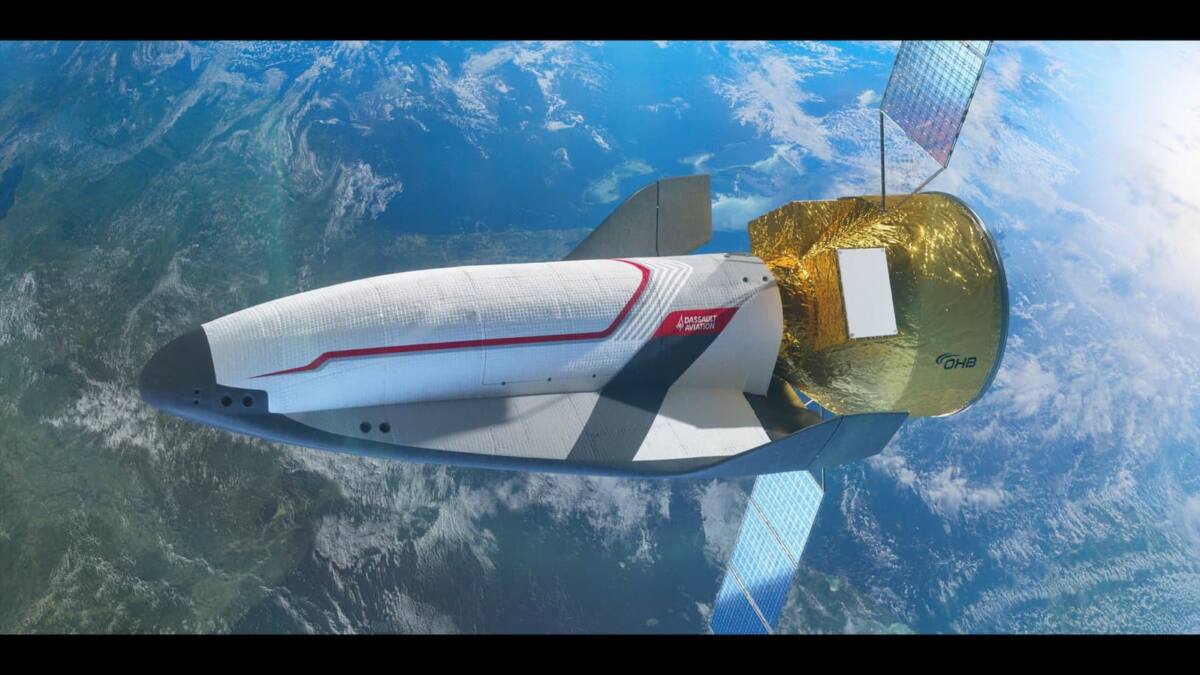
Europe’s answer to the shuttle era may finally be taking shape. Dassault Aviation and OHB have joined forces on Vortex-S, a reusable spaceplane they want to offer to the European Space Agency as a way to give Europe more control over orbital transport, from station deliveries to free-flight science missions.
The pitch is straightforward: build a vehicle that can go to orbit, come back, and do more than one job. That is a familiar dream in spaceflight, but also a hard one, which is why reusable spacecraft have been dominated by the United States so far. Europe has flown plenty of hardware into space; owning the transport layer is a different class of ambition.
What Vortex-S is supposed to do
According to the companies, Vortex-S is designed as a multipurpose spaceplane rather than a single-task cargo craft. It would support regular trips to space stations and return to Earth, while also handling autonomous scientific missions in free flight.
- Reusable orbital spacecraft
- Trips to space stations and back
- Autonomous science missions in free flight
Dassault and OHB split the work
The division of labor is neat and refreshingly unromantic. Dassault Aviation is acting as the prime architect and systems integrator for the spaceplane itself, while OHB is taking charge of the service module and mission-side infrastructure. That pairing makes sense: Dassault brings deep aerospace engineering muscle, while OHB has spent years building satellite and space systems for Europe.
Dassault is also leaning on older European programs as proof that it knows this terrain. The company previously worked on the Hermes spaceplane effort and on IXV, the experimental vehicle used to study atmospheric re-entry. That history does not guarantee success, but it does mean Vortex-S is not starting from zero with a PowerPoint and a prayer.
Why ESA may like the proposal
The real prize here is strategic autonomy. If ESA backs the project, Europe could reduce reliance on foreign launch and transport services while also gaining more room for low-Earth-orbit research, especially biological and physical experiments that benefit from repeatable return trips. A reusable crew or cargo vehicle is expensive to build, but so is dependence.
The consortium is still open, and the companies say they are talking to other European players about joining. That matters because Europe has a habit of producing impressive aerospace ideas and then stretching the decision-making phase until everyone loses interest. If Vortex-S survives the committee maze, the next decade could finally bring Europe a homegrown shuttle-style transport system.