

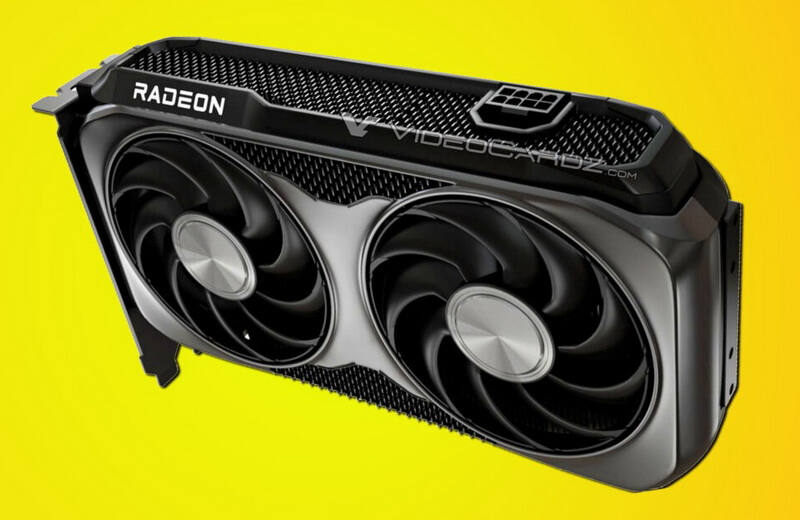
AMD appears to be lining up a cheaper desktop Radeon for its RX 9000 family, and the Radeon RX 9050 looks aimed squarely at the bottom rung of the gaming stack. A new leak points to a card that keeps the RDNA 4 branding but trims clocks and power expectations to sit below the Radeon RX 9060 series.
If the details hold, AMD is doing the predictable thing: reusing the same Navi 44 silicon and selling it in a slower configuration. That is how you fill out a product line without spending money on a fresh chip, and it is also how OEMs get another box to put under a desk.
Radeon RX 9050 specs leak
According to the report, the Radeon RX 9050 uses the Navi 44 GPU with 2048 stream processors, the same count as the Radeon RX 9060 XT. The key difference is that AMD is said to be dialing the clocks back: 1920 MHz in game mode and 2600 MHz in Boost.
- GPU: Navi 44
- Stream processors: 2048
- Game clock: 1920 MHz
- Boost clock: 2600 MHz
- Memory: 8 GB GDDR6
- Memory bus: 128-bit
- Bandwidth: 288 GB/s
That puts it below the RX 9060 XT, whose reference figures are listed at up to 2530 MHz in game mode and up to 3130 MHz in Boost. In other words, the RX 9050 is not a new chip so much as a carefully slowed-down version of one AMD already has.
How the Radeon RX 9050 differs from the RX 9060 and RX 9060 XT
The memory setup is also telling. The card reportedly carries 8 GB of GDDR6 on a 128-bit bus with 288 GB/s of bandwidth, matching the RX 9060 rather than the faster RX 9060 XT, which is rated at 320 GB/s. PCIe support is expected to be the full PCIe 5.0 x16 interface, the same class of connectivity AMD uses on the higher-tier card.
One detail is still missing: board power. But the recommended PSU size is said to be 450 W, versus 500 W for the RX 9060 XT. That suggests AMD is aiming this model at systems that need a more modest, cheaper graphics card rather than a heat-and-power hog dressed up as a bargain.
Why AMD needs another Radeon RX 9000 card
This kind of late-cycle slot-filling is normal in graphics cards. Nvidia has spent years doing the same dance with cut-down SKUs, and AMD itself has often used one GPU to cover everything from premium models down to the entry tier. The point is simple: keep the naming ladder full, keep partners happy, and give buyers a cheaper option before they drift to whatever is on sale.
If the Radeon RX 9050 reaches desktops in this form, it will probably land in prebuilt PCs before it becomes a headline retail card. The real question is whether 8 GB is enough to feel fresh or merely enough to keep the box art honest.