

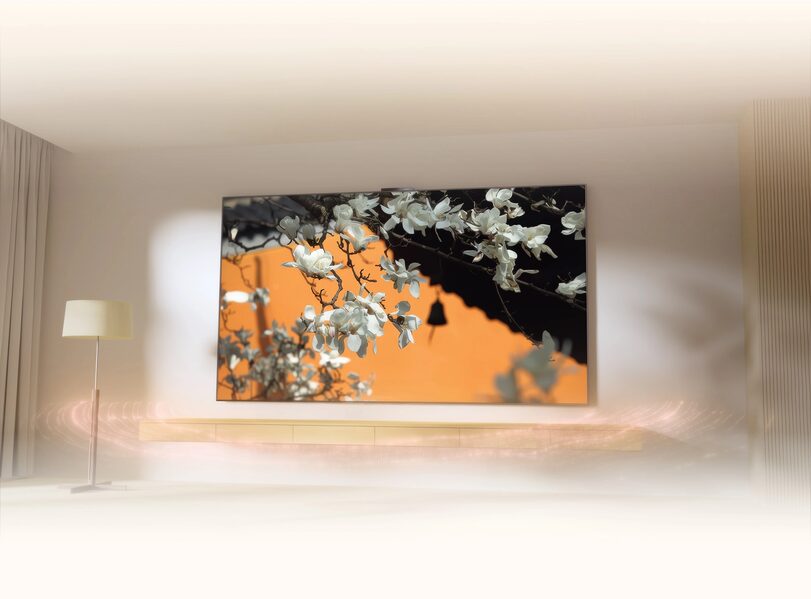
Huawei has launched the Smart Screen S7 lineup, a new family of MiniLED TVs built around Super MiniLED 4K panels, HarmonyOS 4.3, and the company’s Honghu processor. The range stretches from 55 to 98 inches, and Huawei is pitching it as much for gaming and AI features as for straight-up picture quality. In China, pricing starts at 4000 yuan and rises to 13,000 yuan for the 98-inch model.
Two things stand out immediately. First, the refresh rates are aggressive. Second, Huawei is bundling a camera into a product category that many buyers still prefer to keep gloriously dumb. The company clearly wants the S7 to look like a premium all-rounder rather than a one-trick display.
Huawei Smart Screen S7 display specs
The 55-inch to 85-inch models use native 120 Hz panels that can be pushed to 300 Hz when connected to a PC or game console using interpolation algorithms. The 98-inch version steps up to 144 Hz natively and can be boosted to 288 Hz. Peak brightness reaches 1500 nits depending on the model, while color coverage goes up to 95% of the DCI-P3 space.
- Sizes: 55, 65, 75, 85 and 98 inches
- Panel type: 4K Super MiniLED
- Refresh rate: 120 Hz to 300 Hz on smaller models, 144 Hz to 288 Hz on the 98-inch version
- Peak brightness: up to 1500 nits
- Color gamut: up to 95% DCI-P3

Camera, HarmonyOS 4.3 and gaming features
Huawei has also built an 8-megapixel camera into the set for Full HD video calls, complete with a physical privacy shutter. The camera can track posture and distance from the screen, which is either useful parental supervision or one more way the TV gently judges your seating habits.
The software side is anchored by HarmonyOS 4.3, and the hardware includes support for AI-driven features alongside gaming use cases. Audio depends on size, with 2.0 or 2.1 configurations and a subwoofer rated at up to 50 W.
China pricing for the Smart Screen S7
- 55-inch: 4000 yuan
- 65-inch: 5000 yuan
- 75-inch: 7000 yuan
- 85-inch: 9000 yuan
- 98-inch: 13,000 yuan
That puts the range squarely in premium territory, but Huawei is clearly aiming to sell a feature bundle rather than a bare-bones panel: high refresh rates, MiniLED backlighting, a camera, and its own OS all come wrapped into one package.
The bigger question is whether buyers want their next television to be this ambitious. Competitors have spent years pushing MiniLED, higher refresh rates, and voice assistants; Huawei’s twist is to add more PC-like gaming claims and a camera with privacy hardware. If that formula catches on, expect more TV makers to follow with similarly overstuffed living-room slabs.