

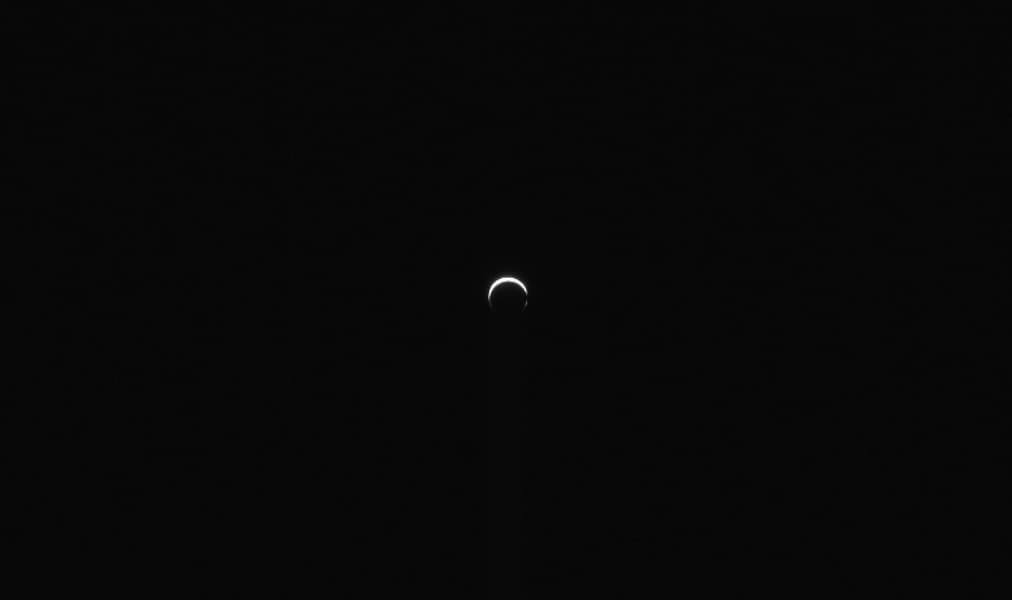
NASA’s Psyche mission has sent back its first close look at Mars ahead of a gravity assist that will swing the spacecraft past the planet on 15 May. The image is more than a pretty postcard: it is a checkup for a deep-space probe that needs Mars to bend its path and save fuel on the long trip to the metal-rich asteroid Psyche.
The color frame, captured on 3 May from about 4.8 million kilometers away, shows Mars as a slim crescent. That is exactly what you’d expect when a spacecraft approaches from the planet’s night side at a high phase angle, but the result is still striking: one of humanity’s most familiar worlds reduced to a bright sliver. The glow around the disk comes from dust in the Martian atmosphere scattering sunlight, while the gap near the north pole may be caused by the winter polar cap and seasonal haze.
How Psyche is using Mars as a gravity assist
The flyby is doing the heavy lifting so Psyche doesn’t have to. On 15 May, the spacecraft will skim just 4,500 kilometers above Mars at almost 20,000 km/h, letting the planet’s gravity change its trajectory and add speed without burning much propellant. That kind of maneuver is standard deep-space logistics, but it’s especially important here because Psyche relies on solar-electric propulsion with xenon rather than brute-force chemical thrust.
That design is efficient, but slow to build momentum. It also means the mission is unusually dependent on precise navigation, which is why a Mars flyby is doing double duty as both a slingshot and a systems test before the spacecraft heads for one of the most unusual objects in the main asteroid belt between Mars and Jupiter.
Psyche’s instruments are getting a workout too
NASA is using the encounter to calibrate hardware before Psyche reaches its target. The spacecraft’s camera will take thousands of observations of Mars, the magnetometer will look for the planet’s interaction with the solar wind, and the gamma-ray and neutron spectrometer will measure changes in cosmic-ray flux nearby. Psyche will also try a trial search for small moons or debris around Mars, a useful rehearsal for the hunt for tiny companions near the asteroid later on.
- Closest approach: 4,500 kilometers above Mars
- Speed at flyby: almost 20,000 km/h
- First image distance: about 4.8 million kilometers
- Exposure time: 2 milliseconds
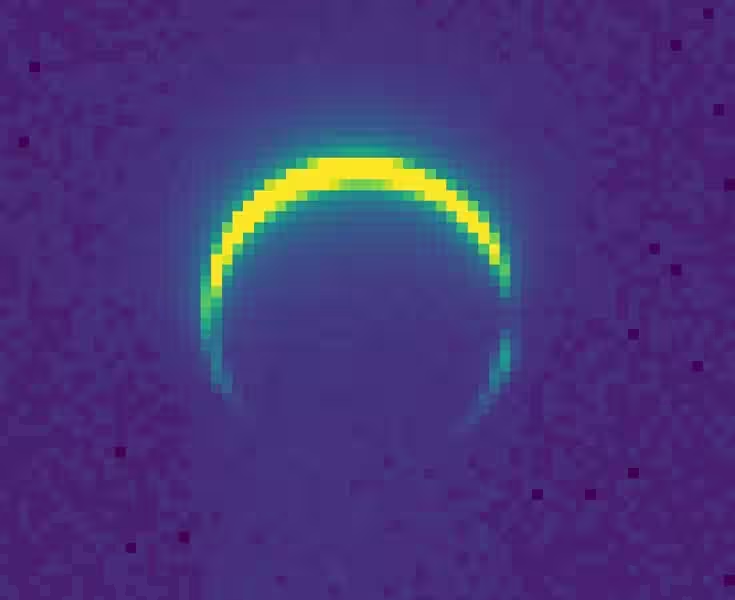
Mission control will watch the maneuver through NASA’s Deep Space Network, with Doppler shifts in the radio signal revealing how the spacecraft’s speed changes almost immediately after the pass. Other Mars orbiters and surface missions, including Mars Reconnaissance Orbiter, Mars Odyssey, Curiosity, Perseverance, Mars Express, and ExoMars Trace Gas Orbiter, will be taking their own measurements too. That cross-checking matters: if you’re about to spend years studying a metal-rich asteroid that may be a fragment of an ancient planetary core, you’d better make sure the instruments are honest.
Psyche launched on 13 October 2023, and the Mars swingby is the mission’s first real dress rehearsal for the asteroid arrival expected in 2029. The bigger question now is whether the spacecraft’s electric propulsion and navigation plan continue to behave as cleanly as this first image suggests – because deep-space missions rarely get many chances to improvise.