

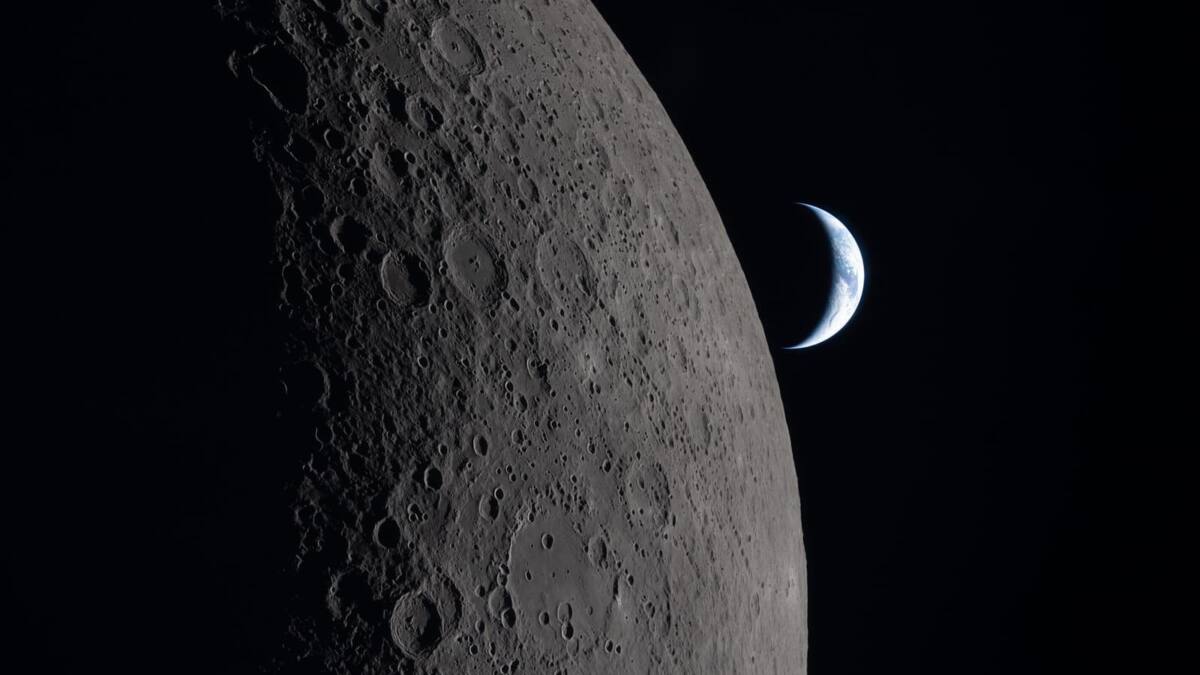
A giant scar on the Moon may finally have a culprit. New modelling suggests the South Pole-Aitken basin, the Moon’s largest and most mysterious impact crater, was carved out by a 260-kilometer-wide asteroid that hit at roughly 13 kilometers per second and at an angle of about 30 degrees.
That matters because SPA is not just another pockmark. Stretching more than 2,500 kilometers across, it is one of the oldest obvious impact features in the Solar System, and the impact may have punched deep enough to fling mantle material onto the surface. In other words: the Moon may have left its own geological receipts lying around.
What the new model says about the South Pole-Aitken basin
The research team, led by Shigeru Wakita at Purdue University, used detailed 3D simulations to test how a huge impact would have behaved. Their answer is a mixed rock-and-iron body, moving fast, striking shallowly, and producing the strange debris pattern seen around the lunar south pole.
- Asteroid diameter: about 260 kilometers
- Impact speed: about 13 kilometers per second
- Impact angle: about 30 degrees
- Crater size: more than 2,500 kilometers across
The shallow-angle detail is the interesting part. A straight-down smash is easier to imagine, but not every giant crater obeys the neat version of the story. An oblique hit better explains how material was spread around the region, and why some of the most valuable samples may sit where future missions can actually reach them.
Why the Moon’s mantle is the prize
Scientists care about SPA because an impact that deep could have exposed material from the Moon’s mantle, the layer normally hidden beneath the crust. Those rocks could help pin down the Moon’s internal structure and narrow the timing of the ancient collision that made the basin in the first place.
NASA’s Artemis program may eventually turn that into actual samples instead of elegant computer models. If the schedule holds, astronauts could collect rocks near the lunar south pole in 2028, which would be a much better way to settle the argument than staring at pixels and arguing about crater physics.
What Artemis samples could reveal
If those samples confirm mantle material really was blasted upward by the impact, SPA becomes more than a record of violence. It turns into a rare window into the Moon’s interior, and possibly one of the best natural archives left for understanding how big bodies were battered into shape early in Solar System history.