

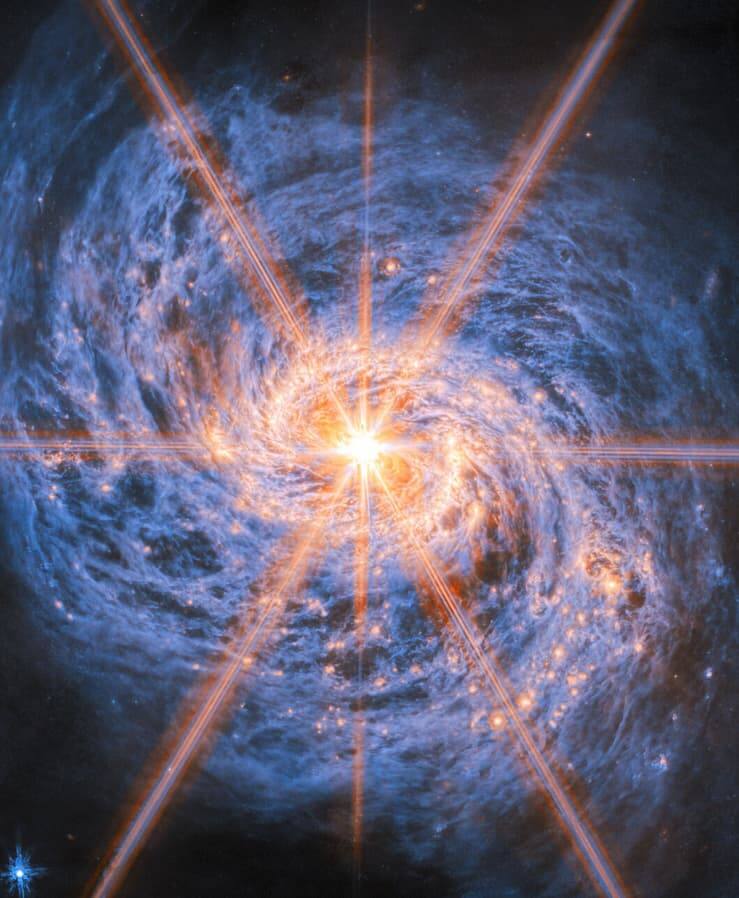
The James Webb Space Telescope has turned its infrared eye on Messier 77 and pulled back the curtain on one of the brightest galactic cores in the nearby universe. The spiral galaxy sits about 45 million light-years from Earth in Cetus, and the new image captures the violent glow around its active nucleus, powered by a supermassive black hole with a mass of about 8 million Suns.
That is the sort of scene visible-light astronomy struggles with. Dust hides the center, gas heats up as it spirals inward, and the best clues come from the mid-infrared, where Webb is built to work. NASA keeps using that advantage to study not just distant galaxies, but the messy physics of black hole growth in systems that still look surprisingly familiar.
What Webb saw in Messier 77
Messier 77 is an active galaxy, which means its central black hole is doing more than sitting there looking dramatic. Material from the surrounding region falls toward the center, forms a dense accretion disk, heats up, and starts pouring out energy, especially in infrared light. The Webb image shows that process with a level of detail that earlier instruments simply could not reach.
- Galaxy: Messier 77
- Distance: about 45 million light-years
- Location: Cetus
- Black hole mass: about 8 million solar masses
- Instrument: Webb’s middle-infrared detector
Why infrared matters for Messier 77
The real win for Webb is not just a prettier picture. Infrared observations can cut through dust that obscures galactic centers in visible light, which is why astronomers keep leaning on this telescope for active nuclei, star-forming regions, and early-universe targets. Compared with older observatories, Webb gives researchers a cleaner read on how black holes feed and how their radiation reshapes the gas around them.
That makes Messier 77 useful beyond its own bright core. Nearby active galaxies like this one are the laboratory cases that help calibrate models for much larger systems, where black holes and host galaxies seem to grow up together in a very non-peaceful partnership.
What comes next for active galaxies
Expect more of these close-up looks. Webb is still in the phase where every sharp image of a dusty, energetic galaxy helps tighten the numbers on black hole feeding, gas dynamics, and the feedback that can either spark or suppress star formation. Messier 77 is not the end of the story; it is one more especially bright chapter in a much larger survey of how galaxies stay lit from the inside out.