

Google has pushed Fitbit into the screenless wearable club with the new Fitbit Air, a $99.99 wrist tracker that skips the display, skips the subscription fee, and tries to out-value rivals like Whoop and Polar Loop with a lighter body and a surprisingly busy feature list. The bet is simple: if your wrist already does the talking, why add a tiny screen full of distractions?
At 0.4 oz. (11 g) including the band, the Air is designed to be forgotten until it nudges you about sleep, workouts, heart rate, or low battery. That kind of stripped-back hardware is becoming a real segment, not a gimmick, because plenty of people now want recovery and activity tracking without another glowing rectangle demanding attention.
Fitbit Air specs and health tracking
The Air tracks the basics: activities, steps, sleep, heart rate, blood oxygenation, skin temperature, cardio load, and heart rhythm. It also includes background AFib detection that is FDA-approved, plus connected GPS when paired with a phone, so mapped runs and rides can still show up in services like Strava.
- Weight: 0.4 oz. (11 g) including the band
- Battery life: up to a full week
- Charging: five minutes for a day of tracking
- Water resistance: 164 ft (50 m)
It automatically recognizes biking, running, walking, elliptical sessions, and rowing, while other workouts are inferred over time from your input in the app. That last part is the usual wearable catch: the device can guess a lot, but your typing finger still gets a vote.
Google Health replaces the Fitbit app
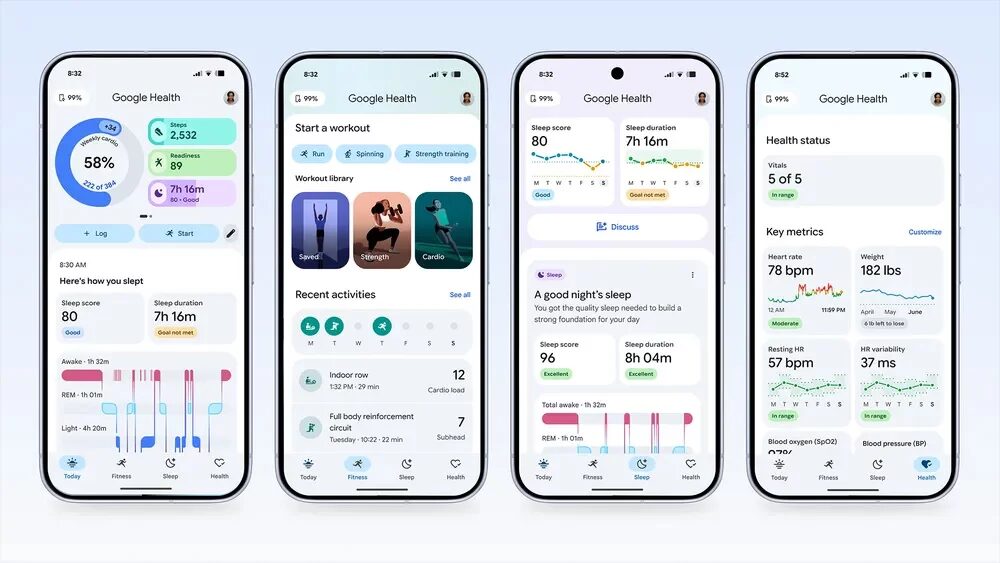
The other half of the pitch lives in software. Fitbit is being rebranded as Google Health, with a redesigned app on iOS and Android that aims to be more intuitive and more customizable. Google is also leaning harder into AI here, offering coaching, workout suggestions, activity insights, medical record summaries, trainer-built workout libraries, and an assistant that answers health questions with evidence-backed responses.
Basic logging is included for free, while Google Health Premium costs US$9.99 a month or $79 a year. For a category that has increasingly monetized even simple metrics, that pricing looks pointed: Google wants the entry-level tracker to feel accessible, then upsell the people who want more interpretation than raw numbers.
The app package also includes mindfulness sessions for meditation and guided breathing, plus schedule tweaks if you need to move workouts around for travel or other chaos. In a market where subscription fatigue is very real, bundling those extras may be the Air’s sharpest weapon.
Price, bands and competition
Google says the Air comes with three wrist wrap styles, and there’s even a Steph Curry special edition that costs $30 more. The tracker is already available to pre-order in the Google Store, and deliveries begin around May 26 in the US, with a three-month free trial of Google Health Premium included.
Against the competition, the price is doing a lot of heavy lifting. At $99.99, it lands around the same level as the Amazfit Helio Strap and at roughly half the price of a Polar Loop, both of which are also subscription-free. If you want richer coaching and analysis, the annual Google Health plan is still cheaper than Whoop’s entry package, which starts at $199 and can climb to $359 depending on features.
The real test is whether Google can make a screenless tracker feel smart enough without becoming annoying or overly chatty. If the readings are solid and the app does the explaining, the Air could put pressure on Whoop’s premium model and push more buyers toward simpler bands that do the job without turning fitness into another monthly bill.