

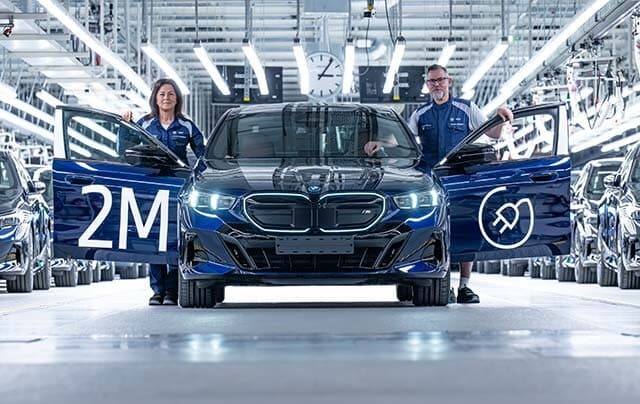
BMW Group has crossed a symbolic line: its two millionth fully electric car has rolled off the line, and the milestone vehicle is a BMW i5 M60 xDrive built in Dingolfing for a customer in Spain. It is a neat snapshot of where the company is headed – still deeply rooted in traditional manufacturing, but now turning electric output into everyday business rather than a side project.
The German carmaker says the model was finished in ”Tanzanite Blue” and serves as the latest proof that BMW’s EV push is no longer experimental. BMW’s broader point is simple enough: scale matters, and it is getting there by using the factories it already has instead of building separate EV-only sites for every new model.
Dingolfing is now BMW’s electric workhorse
Dingolfing, in Bavaria, has become the company’s flagship electric plant. Since serial EV production started there in 2021 with the BMW iX, the site has assembled more than 320,000 electric vehicles – close to one sixth of BMW’s global EV output.
That is not just a nice factory brag. It shows how much of BMW’s electric future is being concentrated in one site that now builds the widest EV range in the brand’s portfolio, from the i5 sedan and Touring to the i7 luxury flagship. In 2025, fully electric cars accounted for more than 25% of total production at the plant, a ratio that would have sounded optimistic only a few years ago.
BMW iFACTORY keeps the lines flexible
The engine behind the scale-up is BMW iFACTORY, the company’s flexible production concept. Instead of isolating EVs in dedicated plants, BMW mixes electric, hybrid, and conventional models on the same assembly lines, letting it shift output as demand changes. That gives the company less glamour than a shiny new EV-only factory, but more practical room to breathe when the market wobbles.
There is also a strategic edge here. Rivals have spent heavily on standalone electric facilities, while BMW has chosen adaptability, which is a polite way of saying it can keep factories busy even if buyer appetite swings between battery power and petrol.
Germany’s EV production still has more room to grow
BMW says every one of its German plants now produces at least one fully electric model, making electrification part of normal industrial operations rather than a special program. That helps reinforce Germany’s position as the world’s second-largest EV producer, with the country’s legacy automakers still proving they can scale zero-emission cars instead of talking about it.
The bigger question is how long flexibility remains an advantage if EV demand accelerates faster than BMW’s mixed-line strategy can stretch. For now, the company has a convincing answer in two million cars and a factory in Dingolfing that looks increasingly like the center of gravity for its electric era.