

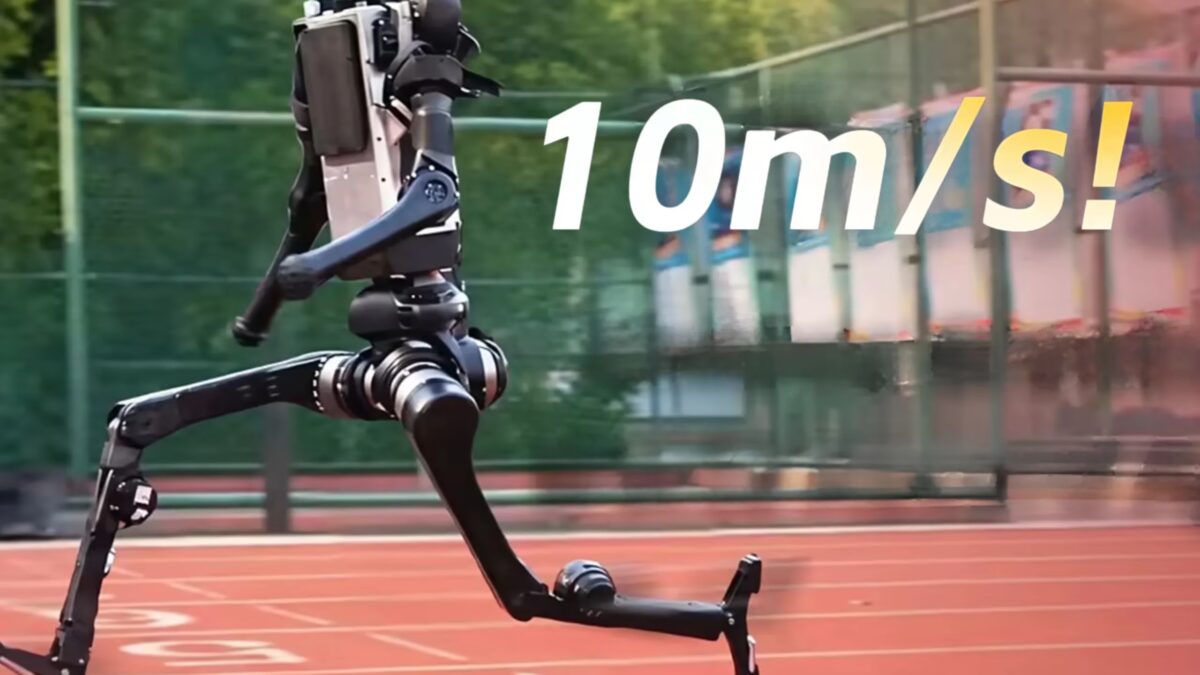
Unitree Robotics’ humanoid robot, the H1, sprinted at a peak speed of 10.1 meters per second over 100 meters, impressively fast for a robot but not enough to beat Usain Bolt’s world record. While the company highlights the robot’s top speed, the actual run time wasn’t disclosed-and Bolt’s record of 9.58 seconds, averaging 10.44 m/s, remains untouchable. Still, the robot’s ability to hit such speeds marks a notable step in humanoid robotics, showcased in a recent video posted on YouTube.
Standing 1.78 meters tall and weighing 62 kilograms, the Unitree H1 features legs roughly 0.8 meters long, with 40-centimeter thigh and shin segments. Its movement relies on custom actuators, powerful motors, a depth camera, and a 3D lidar system for autonomous navigation. Compared to Unitree’s quadrupedal robot, the G1, the H1’s motions appear less fluid and still far from the smoothness of elite human runners.


Beating Bolt’s time demands more than just a momentary top speed-it requires rapid acceleration at the start and sustaining a high average speed throughout the sprint. Bolt managed an average pace of 10.44 m/s, which the H1 has yet to sustain. The video also shows the robot veering slightly off its lane, a violation in official track competitions. This indicates that the robot’s sensors and control systems need further refinement to handle precise lane-keeping and consistent pacing.
For context, elite sprinters benefit from years of biological evolution and training, while humanoid robots are still mastering dynamic balance, power delivery, and real-time adjustments on varied terrain. In the global robotics race, companies like Boston Dynamics have focused on advanced mobility and agility, but few humanoid robots have approached these sprinting speeds. Unitree’s progress thus highlights ongoing advances but also underscores how far the field still has to go.
Experts believe that humanoid robots could inch closer to professional athlete capabilities in the future, as sensor technologies, motor efficiency, and AI control algorithms improve. Achieving Bolt-level sprinting might take years, but the H1’s breakthrough shows the potential trajectory.
The next big challenge for humanoid sprint robots will be balancing speed with endurance, precise steering, and real-time recovery from perturbations on the track. Watching how Unitree and other robotics firms tackle these factors will reveal whether robots can truly compete with human speed champions or will instead pursue complementary athletic roles.
Unitree H1 humanoid robot specifications
- Height: 1.78 meters
- Weight: 62 kilograms
- Leg length: about 0.8 meters (thigh and shin each ~40 cm)
- Movement driven by custom actuators and powerful motors
- Equipped with depth camera and 3D lidar for autonomous navigation
- Peak sprint speed: 10.1 meters per second
Why Usain Bolt’s sprint record remains out of reach
Bolt’s 9.58 seconds over 100 meters isn’t just about top speed; it’s about consistent acceleration and lane control. The H1 only demonstrated a single peak speed without maintaining it throughout the run, and its slight deviations from the lane would disqualify it in formal sprinting events. Achieving this complex coordination requires advanced sensor feedback and agile control systems that robots are still developing.
The future of humanoid sprinting robots
Unitree’s sprinting robot showcases a glimpse of how far robotics has come, but the road ahead includes challenges like faster starts, smoother movements, and reliable racecraft. If these hurdles are overcome, humanoid robots might participate in athletic events as high-performance machines or specialized assistants-opening new arenas where humans and robots push the limits side by side.