

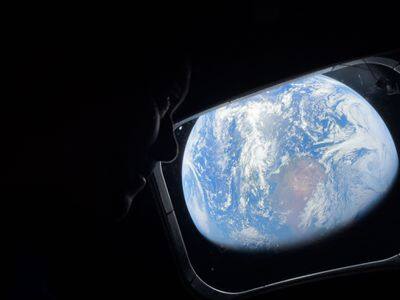
Apple is celebrating a very specific kind of product placement: astronauts aboard NASA’s Orion spacecraft used the iPhone 17 Pro Max to shoot selfies with Earth in the background during Artemis II, and the company is now amplifying the photos after the crew returned safely to Earth. It is the kind of headline that practically writes its own marketing deck, except this one happened far beyond Cupertino’s usual stage.
Tim Cook and Greg Joswiak both posted praise for the mission and for the images, turning a successful flight into a neat little proof point for Apple’s camera branding. NASA had already said in February that the iPhone had been fully qualified for extended use in orbit, and each of the four crew members aboard Orion reportedly had an iPhone 17 Pro Max for personal photos and videos.
iPhone 17 Pro Max photos from Artemis II
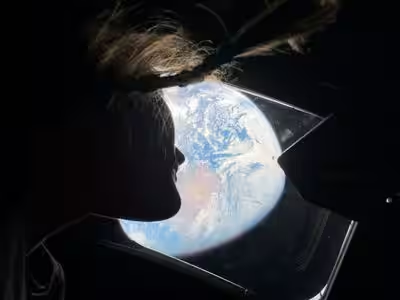
The images Apple is highlighting show Commander Reid Wiseman and Mission Specialist Christina Koch looking back at Earth through one of Orion’s main cabin windows. Flickr data points to the iPhone 17 Pro Max front-facing camera being used on April 2, the second day of the mission. That’s a tidy win for a phone that spends most of its life being judged on beach shots and coffee cups.
Not every frame from the mission came from an iPhone. Other photos shared so far were taken with cameras including the Nikon D5, Nikon Z 9, and GoPro HERO4 Black, which is a useful reminder that space crews still rely on a mixed toolkit rather than one shiny device doing all the work.
Artemis II set a record on the way around the Moon
Artemis II was NASA’s first crewed mission to the Moon since 1972, and the spacecraft reached the far side of the Moon on Monday, setting the all-time record for the farthest distance traveled from Earth by humans. The Orion mission was a flyby only, because the spacecraft does not have landing capabilities, but it still returned on Friday with a neat marketing bonus for Apple and a high-profile validation of the iPhone’s camera hardware.
Apple has spent years pushing the iPhone as a serious imaging tool, while rivals such as Samsung and Google lean on computational photography in their own flagships. NASA’s use case is more extreme than any ad campaign, and that makes it a sharper endorsement than a billboard ever could.
Why Apple is leaning in
The company does not get many chances to say, with a straight face, that its phone helped capture selfies near the Moon. So yes, Apple is leaning in hard. The timing is useful too: the photos arrive just as public attention swings back to Artemis and as the iPhone 17 Pro Max gets a rare, genuinely memorable showcase instead of the usual annual spec-sheet parade.
Expect Apple to keep pointing to this example whenever it wants to talk about durability, camera quality, or confidence in the device’s hardware. The more interesting question is whether NASA’s endorsement nudges other space and research teams toward consumer devices for low-friction photography and video capture. If that happens, the iPhone won’t just be ”shot on iPhone” material anymore; it’ll be part of the kit.