

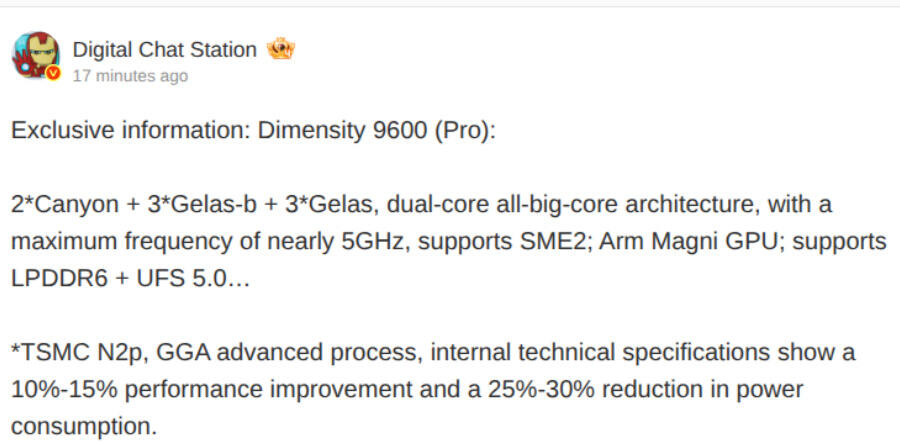
MediaTek’s Dimensity 9600 Pro leak is shaping up as a very loud answer to the next round of Snapdragon flagships. A new leak says the chip will combine near-5GHz peak clocks with a 2+3+3 CPU setup, while keeping the performance bump to a relatively modest 10% to 15% – proof that raw frequency is getting harder to translate into big real-world wins.
According to tipster Digital Chat Station on Weibo, the Pro model uses two ”Canyon” cores, three ”Gelas-b” cores, and three standard ”Gelas” cores, all wrapped in what is described as a dual-core all-big-core architecture. The same leak also points to SME 2 support for machine-learning and AI workloads, plus an Arm ”Magni” GPU on graphics duty.
Dimensity 9600 Pro core layout and GPU
The interesting part is not just the clock speed chase. A 2+3+3 layout suggests MediaTek is trying to squeeze more from a mixed big-core design instead of leaning on a brute-force flagship core alone, a tactic that has become common as chip makers hit thermal and efficiency limits. Qualcomm’s expected rival, the Snapdragon 8 Elite Gen 6 Pro, is also said to be headed toward similar 5GHz territory, but with gains reportedly staying below 20%.
That lines up with the rest of the leak: TSMC’s N2P process, LPDDR6 RAM, and UFS 5.0 storage are all aimed at cutting bottlenecks rather than chasing benchmarks for their own sake. On paper, the combo should make the Pro more efficient than today’s top-end chips, even if the performance jump sounds less dramatic than the headline clocks suggest.
Dimensity 9600 and Pro model split
The leak also reinforces that MediaTek is not treating the Dimensity 9600 family as a single chip with a different sticker. The Pro version is said to get the most advanced setup, while the standard Dimensity 9600 should stay on a 3nm process and target more mainstream phones.
Previous reports have already tied the Vivo X500 series and Oppo Find X10 lineup to the Dimensity 9600. If that holds, those phones will effectively become the first public test for whether MediaTek’s new architecture can turn near-5GHz ambition into something users actually notice beyond the spec sheet.
The real test will be power efficiency
The bigger story here is the ceiling. Once flagship chips all hover around similar clock speeds, efficiency and sustained performance matter more than the marketing number at the top of the spec sheet. A 25% to 30% power reduction, if it survives launch-day reality, would probably be more valuable than another flashy benchmark graph.
What comes next is simple: either MediaTek proves that this mix of new cores, new memory, and a new process can outlast the usual leak-to-launch hype cycle, or the industry gets another reminder that 5GHz sounds better than it behaves.