

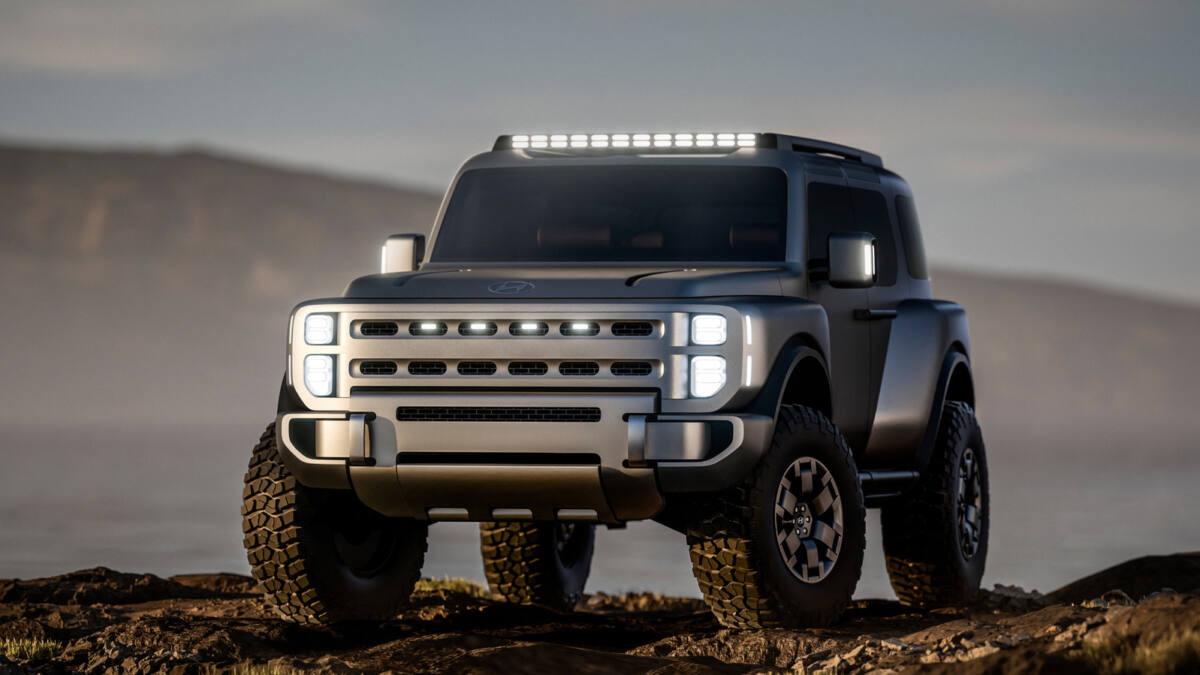
Hyundai has shown off the ”Boulder” concept at the 2026 New York International Auto Show, and it is not trying to play nice with the brand’s usual SUV formula. Instead of the unibody layout Hyundai uses for every other U.S.-market model, the Boulder goes body-on-frame, putting it in the same rough neighborhood as the Jeep Wrangler and Ford Bronco, with a possible overlap into pickup territory, too.
That sounds old-school, because it is. But Hyundai is not treating the platform as nostalgia bait. The company says a truck will arrive first in 2030, with other vehicles to follow on the same hardware, which is a fairly clear signal that this is more than a one-off design exercise. The real story here is Hyundai trying to give off-road vehicles the sturdiness buyers expect without surrendering to the usual compromises.
Hyundai Boulder concept and its body-on-frame SUV layout
Body-on-frame construction is hardly cutting edge, but it still brings real advantages: better towing potential, better durability, and a structure that suits rough use better than the crossover formulas that dominate showroom floors. Hyundai’s pitch is that the Boulder keeps those strengths while leaving room for more wheel travel and differential setups suited to off-roading. That is the sort of engineering shift that can make Jeep a little less comfortable than it should be.
Hyundai also dressed the concept in hardware that sounds suspiciously production-minded. Coach-style side-opening doors and a double-hinged rear tailgate that can open from either side are the kind of features automakers usually park on concepts because they want the applause without making the factory cry. Still, they hint at a vehicle meant to be useful, not just photogenic under convention-center lighting.
The unanswered questions around Hyundai Boulder production
The big unknowns are the ones that matter most: whether Boulder actually reaches production, what drivetrain Hyundai plans to use, and how much it will cost. Those are not small details, especially in a segment where buyers already have strong loyalties and plenty of alternatives. In the U.S., off-road credibility is usually earned the hard way, not announced on a stage.
Hyundai’s move also fits a broader trend among automakers trying to separate genuine off-road vehicles from soft-road crossovers with muddy marketing. If the company follows through, Boulder could become the clearest sign yet that Hyundai wants a serious slice of the rugged-SUV market, not just a badge on a lifted commuter box. The question is whether it can deliver the capability without pricing itself into the same trap that keeps many promising concepts locked behind glass.
What Hyundai is betting on next
If Hyundai’s truck really comes first in 2030, the Boulder may end up looking less like a standalone idea and more like the opening chapter of a whole platform family. That is where this gets interesting: a dedicated rugged architecture could let Hyundai move beyond one halo model and build a lineup that competes on hardware, not just style. Whether that wins over Jeep loyalists is another story, but Hyundai has at least stopped pretending the future of SUVs has to be soft.